Why Auto-Classification Fails on Unstructured Enterprise Data
Meaning-based sensitivity hides from pattern-matching tools built for structured data.

Most business data never gets a chance to say what it is. Somewhere between 80 and 90 percent of enterprise content, per Gartner, is unstructured: emails, contracts, chat logs, presentations, audio and video files, scanned PDFs. None of these formats declare their own sensitivity the way a database field does, and that single fact is the root of why auto-classification tools miss the content that matters most.
A database column labeled "SSN" tells you exactly what it holds. A paragraph in a strategy memo does not. Gartner puts the unstructured share of organizational data at around 90 percent, and a Forbes survey cited by Athento found that roughly 40 percent of companies manage this material on a frequent basis. This is also where the real value sits: product roadmaps, merger terms, source code, negotiation strategy, customer intelligence. The stuff competitors would pay for. The stuff regulators ask about after the fact.
Volume is making the problem worse, not better. Unstructured data is growing rapidly year over year, and projections put total global data volume reaching somewhere around 175 to 180 zettabytes by the middle of this decade. Format diversity, exploding volume, and a basic lack of self-declared meaning: put those three together and you don't have a storage problem. You have a classification problem, and it's one most tools are not built to solve.
What auto-classification tools are doing when they scan a document
Strip away the marketing language and three approaches dominate the market: regex and pattern matching, metadata rules, and static label taxonomies.
Regex scans for fixed string patterns, credit card number formats, Social Security number formats, internal document codes, and fires when it finds a match. Metadata rules classify based on file properties instead of content: who owns the file, where it sits, when it was created, what template generated it. Static label taxonomies hand a hierarchy to a user or system (Public, Internal, Confidential, Restricted) and apply a tag based on a keyword hit or a manual selection.
All three share the same blind spot. They read surface features. None of them read meaning.
That's not a design flaw so much as a design choice made for a different problem. These methods were built for an environment where sensitive data announces itself: a 16-digit number in a specific format, a regulatory keyword, a known template. Unstructured IP almost never cooperates that way. "The facility." "Project Nightingale." "The revised terms." Sensitivity lives in what these phrases refer to, not in the string itself, and a string-matching tool has no way to ask what something refers to.
This matters because classification labels are not the end of the process, they're the beginning. Once applied, a label drives DLP rules, access controls, audit trails, and incident response. Every one of those downstream systems trusts the label. When the label is wrong, so is everything built on top of it.
Why regex and pattern matching score zero on the content that matters most
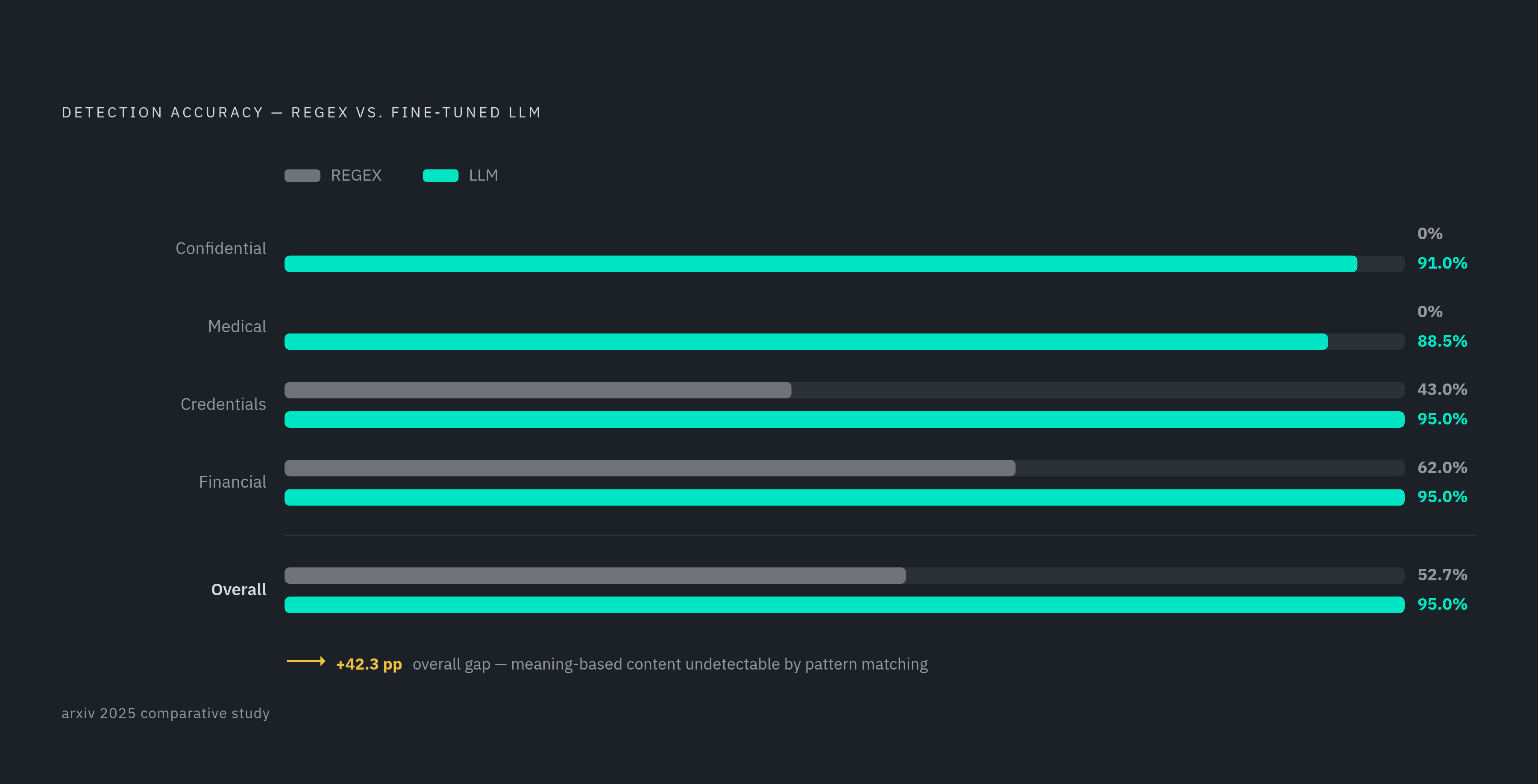
In a comparative study published on arxiv in 2025, regex scored 0 percent on confidential and medical content, the two categories where sensitivity is determined by meaning rather than format. Across all content categories, regex landed at 52.7 percent overall, against 95.0 percent for a fine-tuned LLM. A 42.3 percentage-point gap, in one study, on the exact task these tools are sold to perform.
Even in categories where you'd expect regex to have a fighting chance, credentials, financial data, formats with at least some structure, it still lagged the LLM by 12 to 52 percentage points. Context-dependent content beats pattern matching even when the subject matter has real structure to grab onto.
The failure mode appears in specific, almost comic ways. Regex will flag a tutorial's placeholder API key as a live credential while missing a real secret expressed in plain sentence form. And there's a naming clash sometimes pointed out: the same word, "facility," classifies as a loan in a credit agreement and as a manufacturing plant in an operations report. A regex has no mechanism to tell those apart. Resolving that ambiguity requires reading the sentence, not scanning it for a string.
Separately, research on enterprise log classification found deep learning models substantially outperformed regex, achieving 0.93 F1 on URLs and 0.88 F1 on user IDs. Even semi-structured data, the kind with some predictable shape to it, defeats pattern rules once you're operating at real enterprise scale.
In extremely stable, fixed-format domains, regex still performs fine. The trouble is that IP and business-sensitive content almost never lives in a fixed format. It lives in prose.
The two failure modes that follow from pattern-based classification, and which one is quieter
Pattern-based classification fails in two directions, and only one of them gets noticed quickly.
Over-classification is the loud one. A regex matches nine-digit strings across a shared drive and flags every document in sight as PCI-restricted, including order confirmations that have nothing to do with payment cards. Sales can't get to its own files. Finance escalates. Someone spends an afternoon doing manual review just to unstick a workflow. Because this failure is visible and annoying, organizations respond to it, usually by loosening the thresholds that caused it.
Loosening thresholds, of course, makes the quieter failure worse.
Under-classification doesn't announce itself at all. A spreadsheet full of Social Security numbers gets tagged "Internal" instead of "Restricted," access controls treat it accordingly, and now it's readable by anyone with a company login. Nobody notices, because nothing breaks. It becomes visible only when an auditor finds it, or when someone with worse intentions does first.
Complicating this further: a single document often needs several labels at once. It might touch three business lines, reference two regulations, and name a dozen entities, none of it caught by a taxonomy built to assign one label per file. The most dangerous unstructured IP in a company frequently carries no label whatsoever, because its sensitivity comes from what it means to the business, not from matching a string in a policy file somewhere. Roughly 95 percent of businesses are reported to say unstructured data management is a significant problem, and 71 percent are reported to struggle specifically with protection and governance for it. Those numbers are what both failure modes look like after they've been compounding for a while.
Classification failures don't stay in the classification layer, they propagate downstream
Classification functions as an input layer feeding systems across the organization, not a standalone task sitting off in a corner. It's the input layer for DLP, insider risk detection, access control, compliance audits, and incident response. Every one of those systems consumes the label as ground truth. Get the label wrong and every decision built on it starts from a false premise.
Consider how DLP actually fires on label mismatches. An unlabeled file sails through a DLP check untouched. A mislabeled file trips a false positive that burns analyst time on nothing. Either way, the real risk sitting in the document goes unaddressed.
AI copilots make this worse at scale, not because the technology is malicious, but because it inherits whatever permissions are attached to the labels it's given, and it can pull together and aggregate sensitive material across a company faster than any individual employee ever could manually. Combine that with over-permissioned access, already a known weak point, and classification gaps stop being a niche IT annoyance and become systemic exposure. Over-permissioned access is widely recognized as a persistent enabler of successful attacks.
There's a regulatory dimension too. Legal analysis cited in the research points to unlawful international data transfers and insufficient legal basis for processing, including invalid consent, as the top drivers behind GDPR fines exceeding €1 million. Mislabeling in that context carries consequences reaching well beyond a security lapse. It's a line item.
IBM's 2024 Cost of a Data Breach report puts the average breach at $4.88 million. A misclassified file at that point becomes a balance-sheet problem, extending far past a taxonomy issue. It's a balance-sheet problem.
Because classification sits upstream of the entire stack, a structural flaw there doesn't cause one failure. It seeds a whole family of them, each one downstream system inheriting the same bad assumption.
Why this failure mode is structural, not a calibration problem the vendor can patch
The standard vendor response to a classification miss is to add another rule, tighten a threshold, or expand the keyword list. That treats a symptom. It leaves the cause untouched.
The cause is that regex and static rules operate on surface features, and sensitivity in unstructured content is a function of meaning: what a document is actually about, who wrote it, where it's headed, and what it represents to the organization that produced it. No amount of pattern refinement gets you closer to meaning, because pattern matching was never built to hold meaning in the first place.
So every new edge case demands a new rule, and the rule set grows more brittle and more expensive to maintain as content volume and variety climb. That's not a system learning. That's a system accumulating technical debt, one exception at a time.
The field has largely reached this conclusion already. Sixty percent of enterprise IT leaders name unstructured data classification as a major technical barrier to scaling AI, and 62 percent list reducing data risk from AI as their single biggest unstructured data challenge. In its research on overcoming DLP challenges posed by generative AI, Gartner has indicated that conventional DLP cannot effectively manage GenAI data loss risks. When the analyst firm most enterprises turn to for DLP guidance says the baseline tool isn't sufficient, that's not a maturity gap waiting to close with the next release. That's an architecture problem.
Pattern matching cannot infer meaning. Meaning is exactly where sensitivity lives in unstructured content. A company's most valuable data usually carries no label at all, not because nobody got around to labeling it, but because its value comes from what it means to the business rather than from matching any known string.
What changes when classification is built on content understanding rather than pattern matching
Content-aware classification reads what a document is about instead of what strings sit inside it. It can tell the difference between "the facility" as a loan covenant and "the facility" as a warehouse address, because it's parsing the sentence around the phrase rather than the phrase in isolation.
The gap isn't small. The same research that clocked regex at 52.7 percent overall put LLM-based classification at 95.0 percent. That's not an incremental gain from a better rule set. It's a different capability class.
Practically, this shifts what practitioners define. Instead of building out pattern libraries string by string, they write natural-language definitions of what "sensitive" actually means inside their specific business context, backed by examples and validation. The emerging standard, pairs those definitions with behavioral context: who's interacting with the content, what they're doing with it, where it's traveling. A document's risk level isn't fixed at the moment of creation. It shifts with use.
That behavioral layer matters more than it might sound like it should. A file legitimately shared with an outside partner and the same file staged for exfiltration can look identical to a classifier reading content alone. The activity pattern around the file is part of the signal, arguably as important as the content itself.
None of this works if discovery happens after the fact. Classification applied only to the fraction of content someone thought to point it at leaves the rest of the risk untouched, so discovery has to come first, spanning silos, formats, and platforms before a label ever gets assigned. And the label itself needs to keep working after assignment: content gets copied, transformed, forwarded, and a one-time snapshot label goes stale the moment any of that happens. The goal is a label that travels with the data and updates as context changes, not a stamp applied once and forgotten.
What effective protection of unstructured IP requires in practice
The IP that actually matters, roadmaps, source code, M&A terms, negotiation positions, tends to be unstructured and unlabeled at precisely the moment it's most exposed. That's not a coincidence. It's the direct consequence of everything covered so far.
Most of the risk isn't coming from villains, either. Ponemon Institute's 2025 Cost of Insider Risks report puts the average annual cost of insider incidents at $17.4 million, and attributes 55 percent of those incidents to negligence rather than malice. The population generating classification risk, in other words, is mostly careless, not adversarial, which changes what a defense needs to catch.
Speed matters as much as intent. The same Ponemon report found insider-driven incidents took an average of 81 days to detect and contain, a window that stretches even further when the file involved was never labeled in the first place, because nobody's watching a file nothing flagged. And when insiders are malicious, the cost is the highest of any initial threat vector measured, reaching an average of $4.92 million per incident. IP exfiltration by a departing employee isn't a tail-risk scenario tucked into an appendix somewhere: research suggests a substantial share of IP theft occurs of IP theft within 90 days of an employee's resignation. That's a predictable window. Detection should be sharpest exactly there, and for most organizations, it isn't.
A real program has to combine four things that pattern matching alone was never going to deliver: content understanding, so the system knows what the data actually means, behavioral context, so it knows who's touching it and how, identity and role, so it can tell whether the access pattern fits the person, and destination, so it knows where the data is actually going.
Getting the detection right doesn't finish the job, either. A platform that flags genuine risk but buries the analyst in noise hasn't solved anything, it's just moved the bottleneck. Mean time to investigation matters as much as raw detection accuracy. The direction the field is moving combines AI-driven classification with behavioral detection and investigation context assembled ahead of time, so that when a real signal does appear, the analyst isn't starting from zero. Security teams evaluating tools in this category would do well to ask two blunt questions: how does this handle content that carries no label at all, and does it look at the file, or does it look at the file plus everything happening around it?