Measuring False Negative Rate in DLP Programs
Most security teams cannot measure whether their DLP actually stops real exfiltration.

A DLP program's quality comes down to one number: how much exfiltration actually got through without being flagged. That number is the false negative rate, and most security teams running DLP today cannot tell you what theirs is. Teams boasting a low false positive rate and a high block rate often have the worst false negative rates of anyone, because the easiest way to shrink the first two numbers is to narrow what the system looks for. Secure.com found that 92% of organizations admit missed alerts have already led to security incidents, which tells you the blind spot is not theoretical. The rest of this piece makes the case that the problem is not a tuning failure, but a measurement failure built into how DLP programs are run.
Standard DLP reporting tracks alert volume, block rates, and false positive counts, all of which come from events the system actually caught. An event the system never flagged leaves behind no log entry, no ticket, no line in a dashboard, so nothing in a typical DLP report even hints at its existence. The formula for false negative rate is simple on paper: FN divided by the sum of FN and true positives, where FN is the count of real exfiltration events the system failed to catch. The hard part is that counting FN requires a ground truth the detection engine itself has no way to produce, since it would have to know about the very events it missed. True negatives, false positives, and true positives all appear in system output somewhere, but false negatives appear nowhere, because the system filed them as true negatives and moved on without complaint.
False negative rate and sensitivity (the true positive rate) are mathematically tied together, since FNR equals one minus TPR. That means if a program has never tested its detection rate against a known set of exfiltration attempts, it has no real basis for believing its false negative rate sits anywhere close to acceptable. Lacking that test, most programs fall back on substitutes: how broad their policy coverage looks, the ratio of alerts to blocks, how clean their last compliance audit came back. Each of those answers a different question, and each can trend in a reassuring direction even as the actual rate of missed exfiltration grows unmeasured beneath them.
How False Positives and False Negatives Are Structurally Linked in DLP Programs
The standard fix for a DLP program drowning in false positives, tightening rules, raising alert thresholds, disabling the noisiest policies, is also the single biggest driver of rising false negative rates. That response treats the symptom and feeds the disease, because it reduces how often the system speaks up without changing whether it catches anything real.
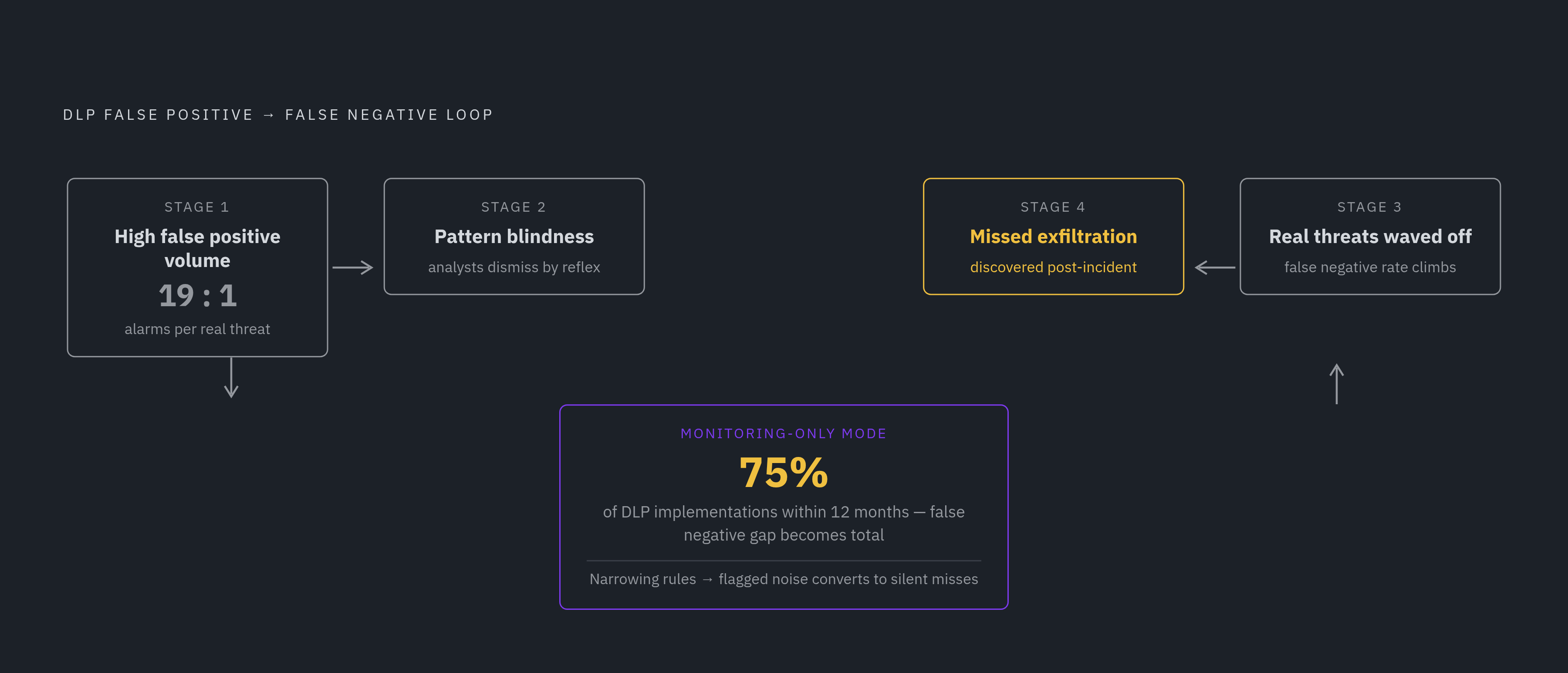
The mechanism runs through the analysts reviewing the alerts. When analysts face something like 19 false alarms for every genuine threat, they start dismissing warnings out of habit rather than judgment, and the research literature calls this pattern blindness. After an analyst has seen hundreds of false positives trace back to the same misconfigured rule, that alert type gets ignored by reflex, even on the one occasion it is reporting something real. From there the loop closes on itself: a high volume of false positives produces pattern blindness, pattern blindness causes genuine threats to get waved off as noise, the effective false negative rate climbs, and the missed exfiltration is discovered, if it is discovered at all, only after an incident has already happened.
Narrowing a rule to cut down false positives shrinks the surface the system is watching. Anything that used to fall inside that surface and no longer does doesn't vanish, it just stops generating a false positive and starts generating a false negative instead. Narrowing the rule converts that risk from noise the system reports into a miss the system never records. Programs built on content-only DLP feel this most acutely: content-only systems generate roughly three times more false positives than context-aware systems, so teams running on pattern matching alone face the strongest pressure to narrow their rules and the biggest resulting blind spot once they do.
The industry's most common response to false positive fatigue is to drop a policy into monitoring-only mode, which removes the complaint by removing the block. Roughly three-quarters of DLP implementations are in monitoring-only mode after twelve months, so every exfiltration event that would have required a block during that period went through unblocked. At that point the false negative gap becomes total for anything running under that policy.
Some teams will argue that choosing high precision over high recall, blocking only what you're certain about, is a deliberate and defensible design decision rather than a failure. That's a fair position, but only if the team has actually measured what the narrower policy lets through. Without that measurement, the choice was never really a decision about acceptable risk. It was a guess dressed up as a policy.
Why legacy DLP architecture makes false negatives structurally inevitable
Static, rule-based DLP was built for a world of known data patterns moving through a small number of controlled channels, email gateways, file servers, a handful of sanctioned applications. That world describes a shrinking fraction of how data actually moves through a hybrid cloud, SaaS, and AI-tool environment today. The architecture itself, not just its configuration, guarantees a certain volume of false negatives.
Rule-based detection only catches what someone already anticipated and wrote a rule for. A novel exfiltration path or a slow one produces no rule violation. That means no alert, and no record that anything was missed. It simply never appears. Network DLP compounds this by only watching the path it was configured to inspect, so transfers over local USB writes, encrypted application channels, or air-gapped systems create dead zones no static rule can reach, because the traffic never passes through the inspection point.
The authorized-channel problem sits at the center of this. When an insider moves data through Slack, Salesforce, and Google Drive, tools the organization has already approved, each individual action looks compliant on its own, and a rule written to catch "sensitive data leaving the organization" never fires because the destination is one the company sanctioned. The Rippling vs. Deel case from March 2025 is the clearest documented instance of this failure mode: an alleged insider with legitimate access used exactly those three approved tools to move information out, an authorized user operating authorized tools toward authorized destinations, which is precisely the combination static DLP has no structural way to flag.
AI tools have opened a parallel version of the same gap. An employee pastes source code, customer records, or financial data into an AI tool running on a personal account, the transfer completes the instant the prompt is submitted, and the data is gone before any review could happen. No traditional DLP rule fires, because from the system's point of view the action looks like an ordinary browser upload to a productivity tool, not an exfiltration event.
Pattern-matching rules fail for a related but distinct reason: they match shape, not meaning. A regex built to catch 16-digit sequences will trigger just as readily on a product serial number, a conference call PIN, or an order confirmation number as it will on an actual credit card number, and it will miss any sensitive data that happens not to match its pattern. Spin.ai's analysis puts legacy regex-based DLP detection accuracy at around 25% at best. The methods dominating exfiltration today, authorized-channel movement and AI-tool pasting chief among them, are the methods legacy DLP was never built to see, and that mismatch is the real story here, not the length of the list of possible exfiltration routes.
The Departing-Employee and Slow-Exfiltration Archetypes
Two archetypes make the structural argument above concrete, and both involve the same underlying conditions: authorized access, incremental movement, and a timeline long enough that no single event ever crosses a detection threshold.
The departing-employee pattern is the clearest case. Suspicious data movement often starts as much as six months before an employee announces their resignation, and most insider IP theft happens within thirty days of that announcement, a window during which the employee's access remains fully authorized and their behavior shifts slowly enough that no individual action trips a rule. Data exfiltration does spike sharply in the hours before a layoff, but the bulk of the value typically leaves earlier, over weeks, through incremental transfers that each look like ordinary work. Personal cloud storage has become the primary channel for this kind of departure, and network DLP may never even see the upload if it goes through an encrypted personal account instead of a monitored corporate SaaS endpoint. The M-Trends 2026 report found that espionage-linked intrusions can persist for months before anyone detects them, which puts the false negative window for a determined insider or a compromised account in terms of weeks or months rather than hours.
The second archetype is the data itself. The most valuable intellectual property a company holds, architecture documents, strategic plans, proprietary models, often carries no label and matches no regex, because content-only classifiers were never trained to recognize it. That data is sensitive because of what it means to the business, a quality no pattern-matching rule can check for. Both archetypes point to the same conclusion: the exfiltration scenarios that cause the most damage are structurally the ones legacy DLP is least equipped to catch.
Why "apparent" false negative rate systematically understates true false negative rate (and what measurement theory says about that gap)
Diagnostic testing research offers a useful borrowed vocabulary here. When the reference test used to judge a diagnostic test is itself imperfect, the measured sensitivity and specificity only describe performance relative to that flawed reference, not true performance, and the true false negative rate can run several times higher than the apparent one. DLP programs face this exact problem, because the detection engine ends up serving as both the system being tested and the source of the ground truth used to test it.
In practice, this means that a program measuring its false negative rate by reviewing the detection engine's own reports and auditing a sample of flagged events is using that engine as its own reference test. Any exfiltration event the engine failed to flag in the first place is invisible to that audit by construction, not by oversight. A false negative rate above a low threshold for high-confidence data patterns signals that exfiltration detection cannot be relied on, yet without an independent source of ground truth, a program has no way to find out what its real rate is.
The accepted way to get around this is the structured proof-of-concept: build synthetic datasets containing known PII, financial data, health records, and intellectual property, run them through the detection system, and measure false positive and false negative rates separately against the known contents of the dataset. That methodology works well at the evaluation stage, before a product is purchased, and it is rarely repeated once the system is actually running in production. Diagnostic statistics also offer a partial answer for programs that cannot build perfect ground truth: bounds on the true false negative rate can still be derived from coverage audits, red-team results, and behavioral telemetry, and a range is informative even when an exact figure is out of reach. Any program relying solely on its own detection output to grade its own performance has built in a circularity that guarantees its apparent false negative rate will read lower than the true one.
Building ground truth that the detection engine cannot supply on its own
Measuring the true false negative rate requires an independent source of ground truth, built from deliberate exfiltration attempts the program did not design its rules around, rather than an audit of what the detection engine already chose to report. Red-team and purple-team exercises are the primary way to generate that ground truth. A useful exercise simulates the actual archetypes a program is meant to catch, departing-employee behavior, slow exfiltration through authorized channels, data pasted into AI tools, uploads to encrypted personal cloud accounts, rather than only the patterns the existing DLP rules were written to catch. A structured version of this test moves synthetic datasets with known sensitive content, PII, financial records, source code analogues, strategic documents, through every monitored channel, then compares what the detection system actually flagged against what was known to be sent. The gap between what was attempted and what the system caught is the empirical false negative rate for that channel and data type, a number the detection engine has no way to calculate about itself. Running this in a purple-team format, with the red team and the detection team working side by side, speeds up the process considerably: the detection team can retune rules in real time as gaps appear, and the red team can adjust its methods in response, which finds blind spots faster than a red-team exercise run blind would.
Coverage audits provide a second, complementary method, and they tend to be the fastest way to find the largest gaps. Mapping every channel through which sensitive data could leave the organization, email, endpoint clipboard, browser upload, SaaS sync, removable media, AI-tool prompt submission, API export, and checking each one for an active monitoring feed reveals the places where no detection is even attempted. Any channel with no monitoring feed has a false negative rate of 100% by definition, which makes this the cheapest and most reliable way to find a program's biggest holes. Because network DLP, endpoint DLP, and cloud DLP each cover a different subset of those channels, a coverage audit has to span all three deployment layers to catch the gaps that fall between them rather than inside any one of them.
Behavioral telemetry supplies a third source of ground truth, and its value comes from the fact that it does not depend on the same rules the content layer uses. User and entity behavior analytics layered on top of content policies gives a program a second detection path, one that can catch activity the content rules never touched. If an authenticated user downloads an unusually large volume of files outside their normal project scope, compresses them, and uploads the result to a personal cloud account, a behavioral system can flag that sequence purely on the deviation from established behavior, with no content rule needing to fire. Comparing behavioral alerts against content-policy alerts shows the cases where behavior caught something content missed, and each of those cases is a candidate false negative in the content layer, so a program gets partial ground truth without the cost of a full red-team engagement. Behavioral baselines need a reasonable stretch of historical data before their alerts can be trusted, and turning on alerting before that baseline period has accumulated tends to produce a flood of false positives severe enough that teams disable the behavioral layer altogether, undoing the very capability meant to close the gap.