Endpoint, Network, and Cloud DLP Coverage Overlap and Gaps
Each DLP layer was built for a different era and leaves dangerous blind spots in modern work.
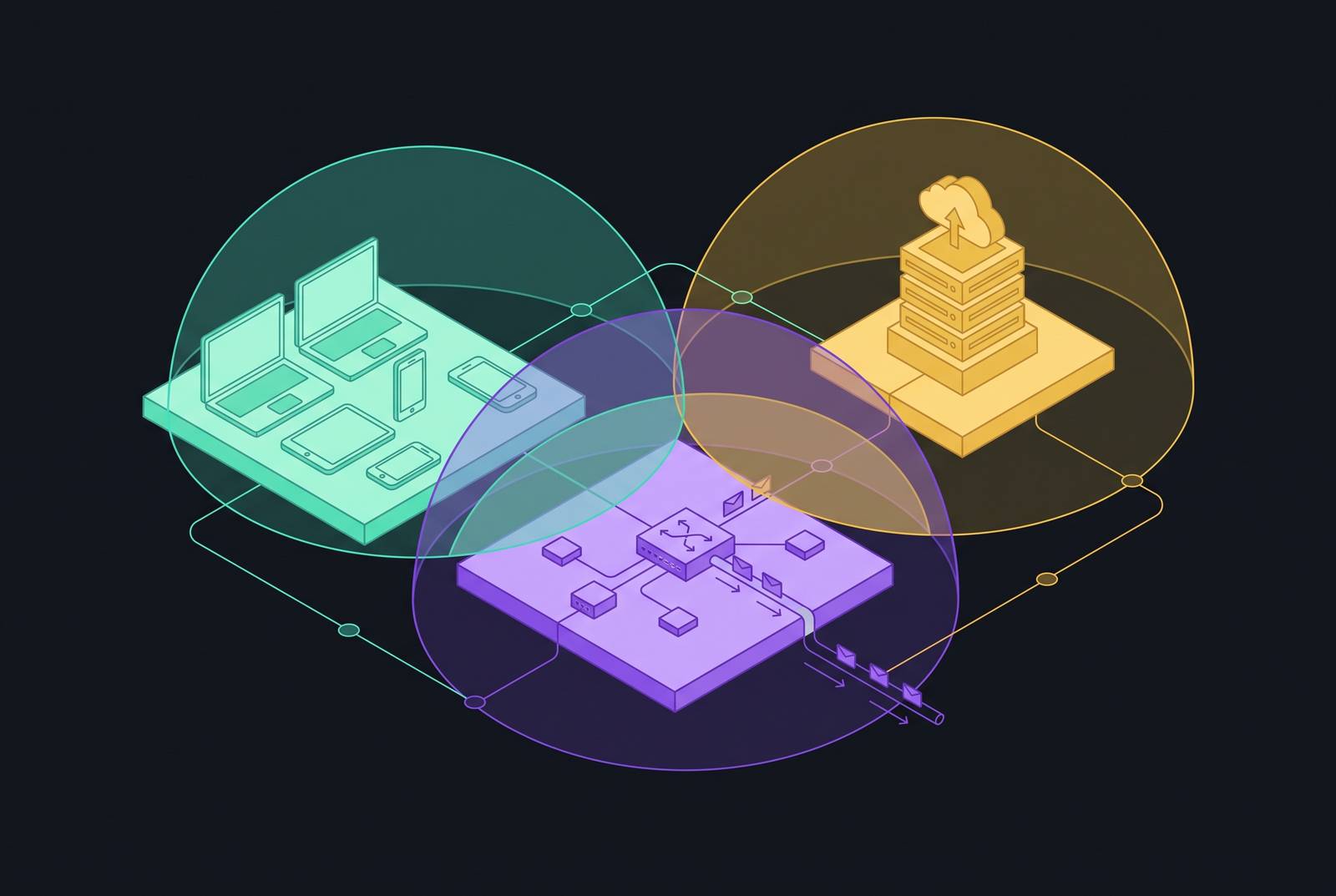
Endpoint, network, and cloud DLP were built in three different decades to answer three different threats, and running all three at once does not produce unified coverage. It produces three partial solutions stacked on top of each other, each carrying assumptions the others don't share, and each going dark in places the others were never designed to see. That distinction matters because most enterprise security teams still budget and plan as if "three layers" means "three times the protection," when the honest accounting is closer to three overlapping maps of the same terrain, each drawn for a world that no longer exists in quite the same form.
Network DLP dates to a period when employees sat inside a corporate perimeter and virtually all traffic passed through a central gateway, a proxy, or an email relay that could be inspected on the way out. That physical arrangement, a workforce tethered to an office network, is no longer the default condition of enterprise work. Remote-first and cloud-first operating models mean sensitive data now moves directly between endpoints and SaaS platforms, with no gateway in the path to inspect it. The architecture wasn't weakened by a new attack technique. It was bypassed by a change in where and how people work.
Endpoint DLP moved enforcement onto the device itself to cover data moving off the corporate network, and for a while that closed the coverage gap network tools left behind. Endpoint protection inherits a boundary of its own: it only works where the agent is installed. It stops cold at the edge of managed hardware. Cloud and CASB controls extended visibility further still, into data sitting at rest in SaaS storage. They address externally shared files, misconfigured permissions, and third-party SaaS access, a different state of data entirely from the movement that the other two layers were built to track. Layered together, the three tools produce strong, redundant coverage of a narrowing slice of enterprise activity, but you get near-total blindness everywhere else.
Where the three layers overlap
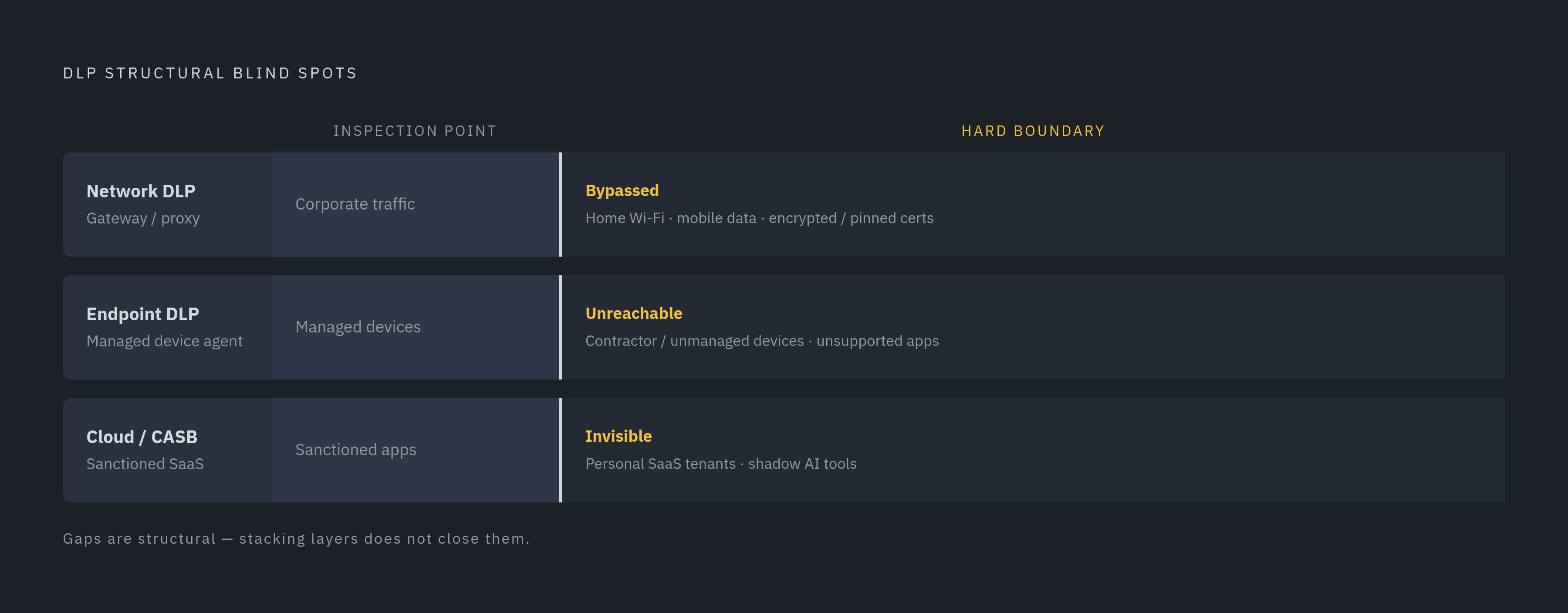
The scenario where all three DLP layers see the same activity clearly is a managed Windows device, connected to the corporate LAN, moving a recognized file type through a monitored application. That scenario describes a shrinking share of how data actually moves inside a modern enterprise. The zone of real overlap is narrower than most coverage diagrams suggest.
Network DLP only enforces what crosses its inspection point, so anything that never reaches the gateway, home Wi-Fi traffic, a direct cloud upload, a connection over mobile data, simply doesn't register. Encrypted traffic compounds the problem: modern applications increasingly pin certificates or rely on mutual TLS, and a network DLP tool that can't break that encryption falls back to filtering by hostname alone. A remote employee who uploads a customer database to a personal Dropbox account over home Wi-Fi never touches the corporate proxy, and the transfer completes without the gateway ever registering it happened. The same blindness applies to AI prompts and clipboard pastes: typing contract language into an LLM chat interface generates an ordinary HTTPS POST request, carrying none of the signals network DLP was built to flag. Personal SaaS accounts deepen the problem further, since personal Google Drive, personal OneDrive, and personal ChatGPT accounts share the same domains as their corporate counterparts, and hostname filtering has no way to tell a personal tenant from a corporate one without device-level context it doesn't have.
Endpoint DLP's blind spot is defined by the agent itself. CrowdStrike Falcon Data Protection shows the boundary clearly: it requires the Falcon agent to run on a managed endpoint, and for defense contractors and supply chain partners, the most sensitive data often moves to people whose devices were never going to carry that agent in the first place, so coverage simply doesn't extend to them. Even on managed devices, endpoint DLP typically watches a predefined list of supported applications, so if a user installs a browser or messaging client outside that list, they can move data out without triggering anything.
Cloud and CASB tools split along a similar line. API-mode CASB is built to address data at rest, externally shared files, public links, misconfigured permissions, not to intercept movement in real time at the point of action, while inline or proxy-mode CASB is specifically designed to catch data in motion as it happens. Either way, coverage ends at the boundary of sanctioned applications. Personal SaaS tenants, shadow AI tools, and unmanaged cloud accounts sit outside that boundary. That gap becomes concrete the moment legal or compliance asks a practical question, like which sensitive data an AI assistant such as Copilot can actually reach: many traditional DLP tools, including those operating at the CASB layer, have no answer to give.
Three data movement patterns that none of the layers were built to catch
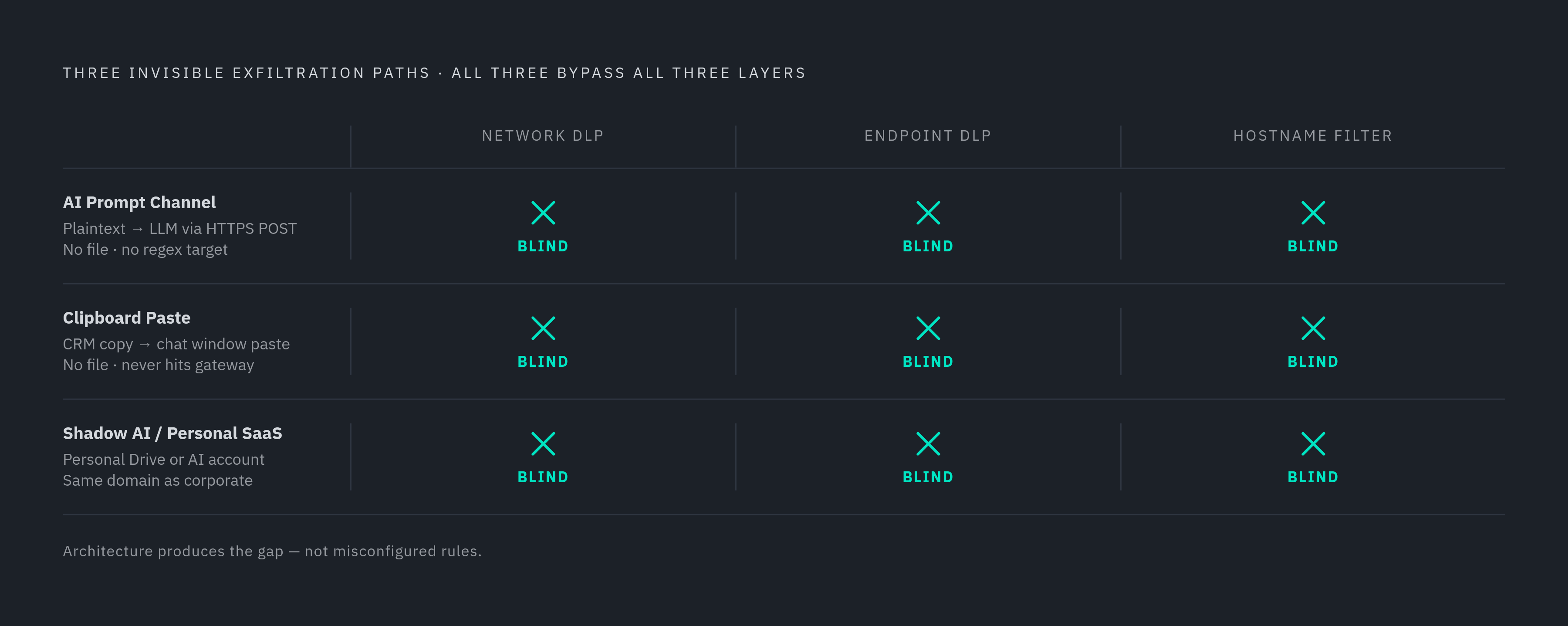
The data movement that matters most inside enterprises today follows paths none of the three DLP layers were designed around, so tuning the existing rule sets harder doesn't close the gap. The architecture itself produces the problem, not how finely the rules are calibrated.
The first pattern is the AI prompt channel. When an employee pastes sensitive contract language into an LLM interface, nothing resembling a file transfer occurs. There's no recognized data pattern, no flaggable destination, just a form submission in plaintext. Content typed into a prompt is sensitive because of what it means, not because it matches a regex, and a detection system built entirely around pattern matching has no mechanism for judging meaning. Research on ChatGPT usage has found that a meaningful share of the data users paste into it contains confidential information, and enterprise adoption of browser-based AI tools has opened data flows that most DLP solutions were never built to monitor. Sensitive data now moves through cloud collaboration platforms, SaaS applications, and GenAI prompts as a routine part of daily work for the broad employee base.
The second pattern is the clipboard paste, which moves content between applications without ever producing a file that leaves the device. An employee who copies a customer list out of a CRM and pastes it into a chat window generates no file transfer the network gateway can see. What the gateway sees is an ordinary HTTPS POST, with the sensitive content buried inside form data the tool wasn't built to parse. Endpoint DLP agents that monitor clipboard activity can catch this pattern, but only on managed devices running applications the agent is configured to watch, so the same unmanaged-device and unsupported-application gaps from the previous section apply here as well.
The third pattern involves shadow AI tools and personal SaaS tenants that operate on the same domains as corporate services. Personal Google Drive, personal OneDrive, and personal AI accounts share infrastructure with their sanctioned corporate equivalents, and hostname filtering at the network level has no way to separate one tenant from another without context about the device making the request. Shadow AI use isn't a fringe behavior confined to a handful of non-technical employees: a meaningful share of the workforce reports using shadow AI tools despite explicit corporate bans, and many organizations have granted AI tools broad access to their collaboration suites without fully realizing the scope of what they've exposed. The gap is widening rather than closing, since new AI tools keep entering enterprise environments faster than any sanctioned list can be updated to track them.
How real incidents map to these blind spots
The incidents that teach the most about this problem are cases where data moved through a path the deployed controls were structurally incapable of seeing, regardless of how well the policy was written.
Take the case of Jinfeng Luo, a former Intel employee who downloaded approximately 18,000 sensitive files before his termination. Intel's DLP system did block one attempt to move that data, but Luo simply switched to a second device and exfiltrated the files through it, prompting Intel to seek substantial damages. The control worked exactly as designed on the managed device and had no relevance whatsoever once the data moved through a second one. This is the canonical endpoint DLP failure: protection bounded by the agent, defeated by the simple act of using a different machine.
A separate incident at Yahoo shows a different failure mode. A senior research scientist downloaded a large trove of trade secrets tied to the AdLearn product within minutes of receiving a job offer from a competitor, a sequence that later led to lawsuits over IP theft. The volume and the timing together formed an anomaly that a system built to understand behavior should have flagged as it happened. Static-rules DLP has no built-in way to recognize "unusually large volume for this particular user in this particular context" unless someone wrote a rule for that exact combination in advance, and no one had.
The Coinbase incident shows contractors sitting outside the managed-device perimeter directly. Contractors and supply chain partners sit outside the managed-device perimeter by definition, since the devices they use were never going to be enrolled in the organization's endpoint agent. That's the structural reason DLP controls fail against this category of insider risk: the perimeter the tools protect simply doesn't extend to the people carrying the risk.
The most difficult case is the pattern tied to DPRK-linked IT workers who gain legitimate employment under false pretenses. That archetype defeats all three layers at once, because the person holds legitimate credentials, works from an authorized device, and accesses data through entirely authorized paths. No policy rule exists to flag authorized access by an authorized user, because the authorization itself is the cover. Detecting that kind of infiltration requires understanding a person's behavior over time relative to what their actual role requires, a capability none of the three static layers were built to provide.
Why static rules produce alert noise instead of signal
Network, endpoint, and cloud DLP all share one detection architecture underneath their different deployment points: static rules applied to data movement, with no model of the person doing the moving or the pattern their activity fits into, and that shared architecture is why the gaps documented above persist, not a lack of investment in DLP tooling.
Rules only catch what someone thought to write a rule for. No one wrote a rule for "employee pastes the name of an acquisition target into a personal LLM account" because no one building these rule sets anticipated that specific data movement path at the time. The universe of possible sensitive data movements has grown larger and more varied than any rule set can enumerate ahead of time, and AI tools are adding new exfiltration surfaces on a continuing basis, faster than policy teams can catalog them.
The mismatch raises alert volume as its operational cost. The majority of DLP alerts generated across organizations are either false positives or simply go uninvestigated, and most organizations now name reducing alert noise as a priority for their existing DLP deployments. That noise is a detection failure in its own right, since genuine threats get buried under the volume of alerts the rules were supposed to generate in order to surface them, beyond its cost to security team efficiency.
Adding more tools on top of this architecture doesn't fix it. Enterprises run more than three tools with DLP capabilities on average, more than half report that integration between those tools is fragmented, and despite running all of them simultaneously, a majority of organizations have still experienced multiple unstructured data loss events. Stacking additional rule-based tools onto additional channels multiplies alert volume without closing a single one of the structural gaps described above. Endpoint, network, and cloud DLP were engineered around different threat models and different states of data, each built to solve for a risk scenario that no longer dominates how data actually moves through an enterprise. Platforms built to apply behavioral profiling across the entire stack, treating the data and the person moving it as a single unit of analysis regardless of which layer or device the activity passes through, are built specifically to surface risk that spans these structural gaps rather than depending on a static rule sitting at one inspection point.
Visibility alone doesn't resolve this either. Knowing that a transfer occurred says nothing about whether it matters: the question that actually determines threat status is who the person is, what's normal for them, and what the surrounding pattern of their activity looks like.
Coverage That Holds: Behavioral Context and Content Understanding
Closing the gaps that three-layer DLP leaves behind means pairing content understanding with behavioral context, not stacking a fourth rule-based tool on top of the first three. A system has to understand what the data means, not just whether it matches a pattern, and it has to understand whether the person moving it is acting inside or outside their normal behavior, since that's the signal static rules were never built to carry.
The overlap between the three classic layers is narrowing as more enterprise data moves through unmanaged devices, personal cloud tenants, and shadow AI tools that sit entirely outside any single layer's field of view. Detection systems that profile behavior across multiple data sources at once, clipboard activity, prompt submissions, lateral movement between authorized and unauthorized destinations, can catch exfiltration attempts in that combined view that no individual layer would ever catch working alone. A single file transfer, a single clipboard paste, a single API call is almost never the risk on its own. The risk lives in the pattern of activity surrounding that single action, the way it compares to what's normal for that person, that role, that moment. Insider risk detection that combines visibility across endpoints, network, and cloud with AI-driven analysis of behavioral anomalies can identify when a given instance of data movement is genuinely aberrant, cutting down the false-positive floods that have made traditional DLP alerts so easy to ignore and letting analysts spend their attention on the cases that actually warrant it.
Candor fits into this discussion as one answer among a developing field of behavioral-intelligence approaches to insider risk, built around the premise that data loss prevention has to account for both the content moving and the person moving it, across whichever layer or device the activity happens to touch. The incidents at Intel, at Yahoo, and in the DPRK IT worker cases all shared one trait: the data moved through a path the deployed tools were never built to see, and the behavior preceding each loss carried a signal that a rule-based system had no way to register. Coverage that holds has to start from that signal instead of a longer list of patterns to match against.