Static Rule DLP Programs and the Gaps They Systematically Miss
Most sensitive data lacks the labels and patterns static DLP rules are built to catch.
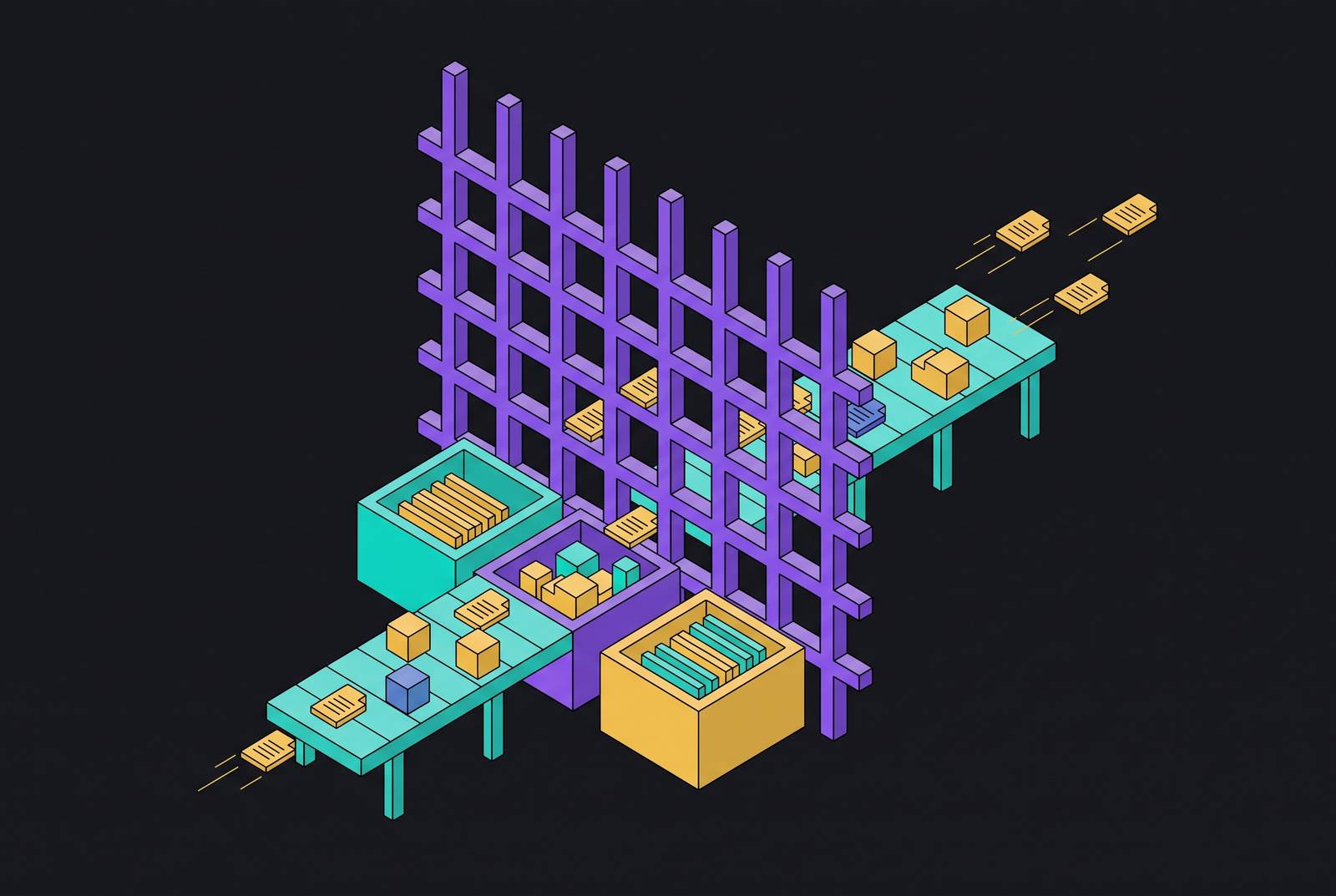
Static-rule DLP programs keep failing because the architecture underneath them assumes something false: that data risk equals data moving across a perimeter. Spending on DLP keeps climbing, programs keep getting deployed, and incidents keep happening at the same pace. That mismatch between investment and outcome is the clearest evidence that the problem sits in the design, not in the tuning.
Static-Rule DLP's Structural Problem
The design premise behind most DLP tooling is simple: a rule fires when data crosses a defined boundary, and inside that boundary, an authenticated user is treated as a trusted one. That premise made sense when collaboration meant attaching a file to an email and sending it outside the company network. It makes far less sense now, when sensitive data lives across hybrid cloud infrastructure, a dozen SaaS applications, and AI assistants that sit inside the perimeter and still move information out of it.
Duality Tech's 2026 analysis states that most regulated organizations already have a data loss prevention policy. No amount of retuning thresholds or adding new regex patterns fixes an architecture that was never built to see where the data actually goes.
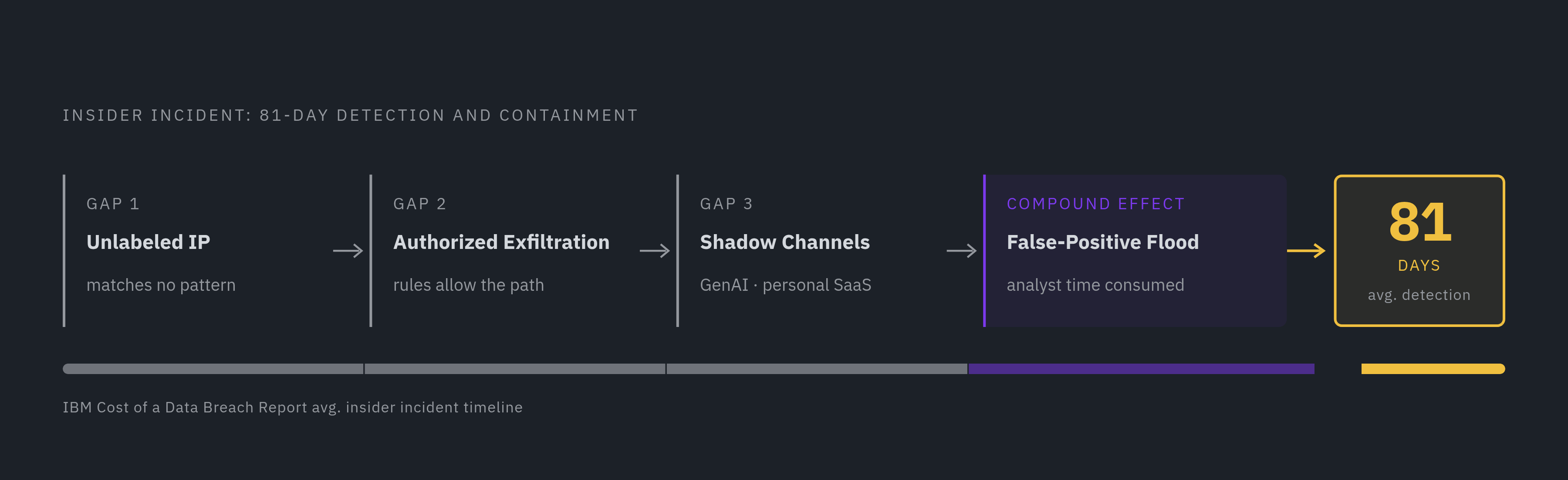
Three gaps follow directly from this design, and they account for most of what static-rule DLP misses. The first is sensitive intellectual property that carries no label and matches no pattern. The second is exfiltration carried out through access the system has already authorized. The third is the growing set of channels, generative AI tools chief among them, that rule sets were never written to cover. Each gap is a direct consequence of building detection around perimeter crossing instead of around the data's meaning and the person moving it.
The first gap: sensitive IP that carries no label and matches no pattern
Content-inspection rules can only act on what they are built to recognize: a regex pattern, a fingerprint, a classification label. Data that fits none of those templates produces no alert, no matter how damaging its loss would be. That is the core limitation of the entire rules layer, and it happens to fall hardest on the data companies care about most.
The New DLP report finds that a large majority of organizations' unstructured sensitive data has never been discovered or classified. Most of the risk sits outside the rules layer before a single policy is ever written against it. And the gap only grows. The distance between what exists and what the rules actually cover widens every quarter.
What makes a piece of intellectual property sensitive has nothing to do with whether it matches a pattern. A spreadsheet modeling a competitive pricing strategy, a slide deck describing an unannounced acquisition, a code repository holding a novel training pipeline: none of these carry a "confidential" stamp, and none trip a regex. None of that was PHI. The most valuable exfiltration is happening in exactly the category static rules are least equipped to see.
The obvious response, classify everything, doesn't hold up under its own weight. Protecting this kind of IP requires understanding what the data means to the business, who created it, what project or deal it belongs to, rather than waiting for it to match a pattern someone wrote months or years earlier.
The second gap: exfiltration through authorized access that rules are designed to allow
Static DLP rules ask one question: is this movement permitted? They don't ask whether the person performing it should be doing so right now. That distinction is the second structural gap, and it means a user acting entirely within their granted permissions can walk data out the front door without triggering a single rule.
The archetype case: a data scientist with legitimate credentials queries a sensitive dataset at 2 AM from an unmanaged device, exports a large file, and moves it to a personal cloud account. Every individual action is permitted. No step crosses a rule threshold. The rules pass every one of them, because each was written to evaluate the action in isolation, not the sequence it belongs to.
This gap isn't limited to malicious actors. The 2025 Insider Risk Report found that 62% of insider incidents come from human error or compromised accounts rather than intentional misconduct. Rules can't distinguish intent in the first place, so they treat a negligent employee, a compromised account, and a deliberate insider identically: as authorized traffic. The Salesloft-Drift OAuth abuse tied to UNC6395 showed what this looks like at scale. Stolen OAuth tokens from a trusted SaaS integration gave attackers silent access to customer environments across hundreds of organizations. There was no exploit and no phishing email to catch. The activity came through a trusted connection and looked exactly like legitimate traffic, because by every measure a rule engine applies, it was.
Offboarding extends the same blind spot. The New DLP report notes that without consistent monitoring and credential revocation, former employees can retain access to cloud environments and SaaS applications well after they leave. Rules written for active employees keep applying to people who no longer work there, because nothing in the rule distinguishes a current staff member from a departed one still holding valid credentials.
The real signal in all of these cases sits in the pattern across a timeline. Without context about the person behind the action, a rule can't tell a risky pattern from a busy week.
The real risk lives in that pattern across a timeline rather than in any single event, so insider risk platforms like Candor take a different approach: assembling endpoint activity, authentication logs, and data access into a single investigation context, so an analyst can tell a legitimate bulk export apart from an exfiltration attempt that happens to travel through authorized channels. That distinction, between what the action looks like and what the actor's recent pattern says about it, is the one static rules structurally cannot make, because they audit the action and nothing about the person performing it.
The third gap: shadow channels that rules were never written to cover
Static rules only govern the channels someone anticipated when writing them. The rapid rise of generative AI tools and personal SaaS applications has opened up a class of exfiltration paths that most legacy rule sets were never built to address at all, and the pace of that growth keeps outrunning the pace at which policy teams can respond.
Rules are written by people, in reaction to threats that are already known. A new application category has to be discovered, assessed, written into policy, tested, and deployed, and by the time all of that happens, the channel is usually already in wide use across the organization. Fortinet's 2025 Insider Risk Report found that a large share of security leaders are seriously concerned about data moving into generative AI tools, and the 2026 Verizon DBIR data shows GenAI-related policy violations happening at a rate that overwhelms manual review inside high-exposure organizations.
What leaves through those channels matters as much as how much of it leaves. The 2026 DBIR's analysis of GenAI upload events found source code to be the top category by a wide margin, followed by images and structured data. That composition matters because these are the kinds of assets whose loss can be competitively devastating, yet none of them carry the kind of regulated-data fingerprint that legacy content inspection is built to flag.
The NSW Reconstruction Authority breach in March 2025 shows how fast and how quietly this can happen. A former temporary employee uploaded a Microsoft Excel spreadsheet, exported from the organization's Salesforce system, containing more than 12,000 rows of flood-victim personal data, to a personal ChatGPT account. The breach played out over a matter of days and wasn't disclosed publicly until months later. Personal cloud apps widen the exposure further. Any policy that only governs managed devices leaves most of that activity completely untouched.
The Microsoft 365 Copilot vulnerability known as EchoLeak (CVE-2025-32711, CVSS 9.3, disclosed in June 2025) points to an even stranger category of risk. A crafted email could plant hidden instructions that the assistant picked up through its own retrieval context, potentially exfiltrating anything within Copilot's reach while the user took no action. That kind of attack leaves no behavioral signature for a static content-inspection rule to match, because no human behavior triggers it.
The problem compounds on itself. Every new SaaS tool an organization adopts, every new AI assistant it deploys, every integration it authorizes is a potential gap until someone writes a rule to govern it, and in most enterprises, tool adoption runs well ahead of policy writing. Shadow AI usage calls for controls that look at the data itself, where it's headed, who owns the destination account, and the context around the transfer, intervening before sensitive data actually leaves rather than waiting for a rule written for last year's tool stack to catch this year's channel.
How the three gaps combine to overwhelm SOC teams, not just evade rules
These three gaps don't just let individual incidents slip through. They produce a second-order failure inside the SOC itself: the volume of false positives generated by blunt static rules eats up the analyst time that would otherwise go toward investigating the real threats the rules are missing.
Broadly tuned static rules catch an enormous amount of legitimate activity along with the risky kind. Analysts learn, reasonably, to treat the alert queue as noise, and once that happens, the rare real signal that does appear in the queue gets the same low-attention treatment as everything around it. The New DLP report finds that nearly half of legacy DLP alerts turn out to be false positives, and that the vast majority of all DLP alerts are either false or simply ignored. Real threats end up sitting in plain sight inside a queue nobody has time to read closely.
The investigation math makes this worse. What arrives in a typical DLP alert doesn't help much either: a data movement event, maybe a file name and a destination, nothing about the user's role, their recent access history, their HR status, or whether they've been querying unfamiliar repositories. An analyst has to go build that context by hand, across several different tools, before even deciding whether the alert deserves attention.
The human side of the SOC compounds the structural side. Insider incidents are a major driver of the annual costs organizations now absorb from data loss, and SOC analyst burnout combined with short average tenure means the institutional knowledge needed to spot subtle insider patterns keeps walking out the door along with the analysts who built it. Put the pieces together, rules that miss all three structural gaps, analyst capacity consumed by false positives, and investigations that require manual work across disconnected tools, and the result is an average detection-and-containment timeline for insider incidents of 81 days. That's an adversary operating with nearly three months of undetected access, produced entirely by the combination of these failures rather than any single one of them. Adding more analysts doesn't fix a problem that scales with the size of the environment. The only sustainable fix is cutting the manual work required per alert, by surfacing the right alert with enough context attached that an analyst can act on it quickly rather than needing to go build that context from scratch.
What closing these gaps requires from a DLP architecture
Closing these three gaps calls for an architecture that understands the data and the person behind the action together, combining content understanding, behavioral context, and channel-aware controls, rather than writing more rules into a system whose rules are the thing that's failing.
For the unlabeled-IP gap, protection has to be grounded in what data means to the business rather than only in what it happens to match. That calls for semantic understanding of content: what a file is actually about, who wrote it, which project or deal it belongs to, not pattern recognition running against a fixed list of regexes. Detection systems that pair behavioral context with data drawn from multiple sources can flag high-risk movement of unstructured IP by looking at who is accessing it and whether that access breaks from their established pattern, sidestepping the classification dependency that a rules-based system can't escape no matter how it's tuned.
For the authorized-access gap, detection has to work across a user's full behavioral timeline rather than judging isolated events on their own. A single export isn't the signal on its own; the signal is that export read against what came before it. That calls for behavioral analysis that doesn't need prior evidence of compromise to function, because by the time compromise is visible, the data has often already left. Insider risk platforms built this way can distinguish a routine permitted action from the same action performed in a sequence or context that makes it genuinely anomalous, surfacing exactly the pattern that turns an otherwise-authorized step into a real threat, while a rules engine treats each action as its own isolated event.
For the shadow-channel gap, controls need to follow the data itself rather than the application it happens to pass through, watching the destination, the account ownership, and the surrounding context so that a transfer can be stopped before sensitive information leaves, rather than waiting for a rule written for yesterday's tool to catch today's. None of this is a case for abandoning rules entirely; pattern matching still catches plenty of straightforward policy violations. It is a case for recognizing that rules alone were never built to close these three gaps, and that the organizations still waiting on better configuration to fix them are solving the wrong problem.