Prioritizing DLP Coverage Investments by Data Value Rather Than Volume
Protect what matters most instead of chasing coverage volume.
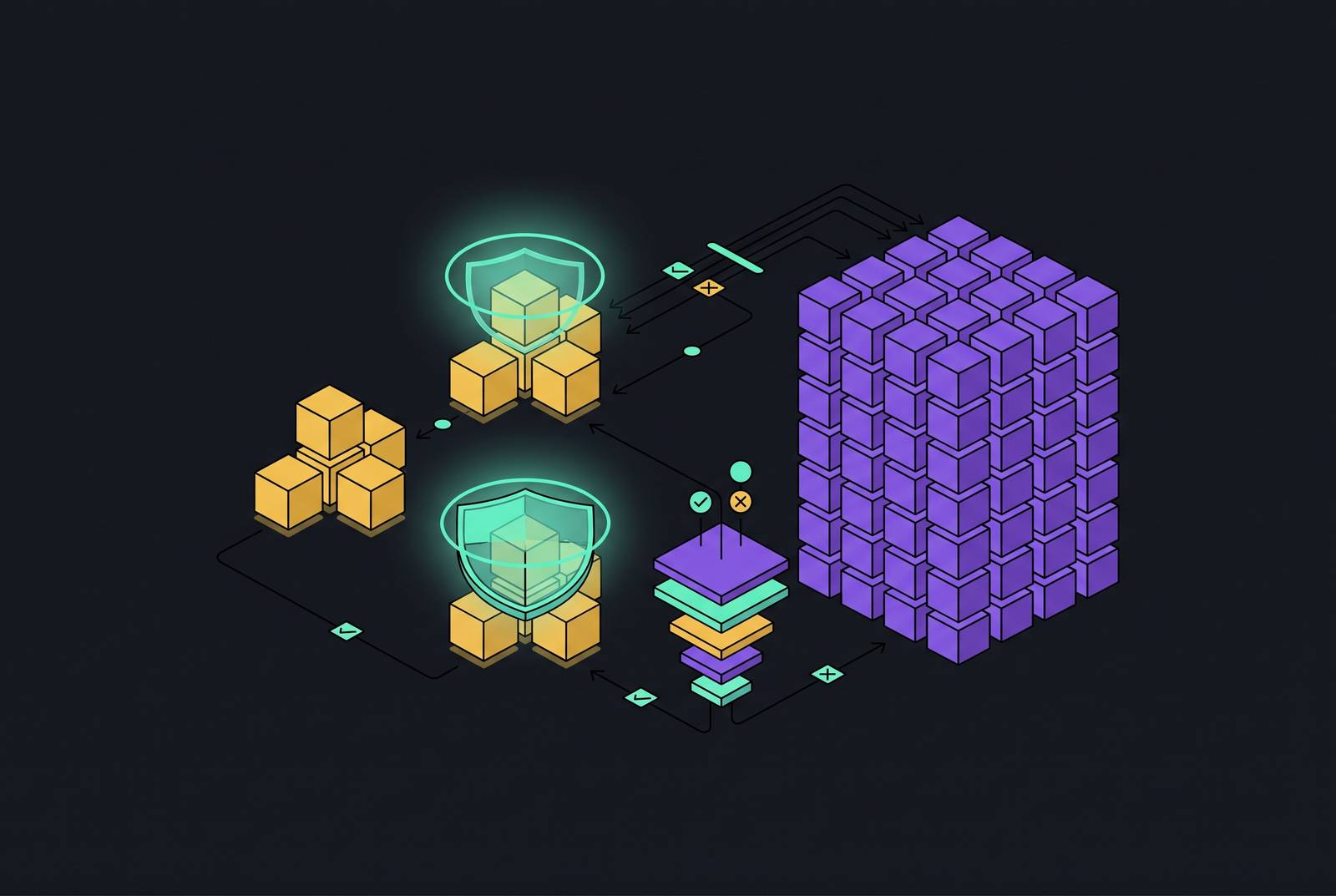
Most data loss prevention programs grow along a single axis: add a channel, add a policy, add an alert type, call it maturity. That expansion looks like progress on a roadmap slide, and it is the default path nearly every program takes once the initial deployment proves it works. But volume of coverage and value of coverage are not the same thing, and the gap between them is where most DLP investment quietly goes to waste.
The failure pattern is specific enough to describe without a single statistic. A team switches a policy to blocking mode before it has been properly tuned. Within weeks, the team is buried under a volume of alerts nobody has the headcount to review Decryption Digest. Somewhere in that pile, a false positive catches an executive's file transfer, and the executive escalates. The policy gets loosened to make the pain stop. This repeats, policy after policy, until what remains is a program that looks complete on an architecture diagram but stops almost nothing in practice Decryption Digest. It sits in audit-only mode, technically deployed, functionally inert, satisfying whoever needs to see a checkbox ticked for compliance.
The pattern is structural. Programs that chase volume, more channels, more rules, more alert categories, are optimizing for a number that looks good in a quarterly review while the actual target, protecting the data the business cannot afford to lose, goes unaddressed.
How the data-value frame works in practice
Compliance-first logic sets a floor: protect what regulators require, in the channels regulators are most likely to audit. It is a legitimate starting point, but it was never designed to be a ceiling. Data-value logic asks a different question entirely: what can the business not afford to lose, regardless of whether a regulation names it, a classifier tags it, or a policy already exists for it?
The gap between those two questions is wide, and it is exactly where competitive advantage lives. Source code, unreleased product roadmaps, proprietary customer models, research still in draft, the target list for an acquisition, none of it typically carries a regulatory mandate, and much of it carries no classification label at all. Trade secrets, product designs, and proprietary research rank among the most valuable assets an organization holds, and simultaneously among the hardest to trace once they leave the building, because DLP's core function, as Forcepoint's DLP guide explains, is tracking how that intellectual property moves and intercepting unauthorized transfers before they complete Decryption Digest.
That has a blunt implication for anyone measuring program success by regulatory coverage alone. Compliance coverage and intellectual property protection are not the same program, even when they run on the same platform. Call it crown-jewel data if the label helps, but treat it as a category defined by consequence to the business, not by a list of file extensions or regulatory citations. Practical implication: a program that covers every regulated data type perfectly can still fail to protect the information that creates enterprise value (compliance coverage and IP protection are not the same program).
Why high-value data is so often unclassified
Regulated data has the advantage of definition. PII and payment card numbers follow known formats, carry legal definitions, and trigger detection logic that has been refined for years. Intellectual property has none of that. There is no eighteen-digit pattern for a product roadmap, no standard format for a pricing strategy document, no keyword that reliably distinguishes a merger target list from routine correspondence https://underdefense.com/blog/dlp-solutions/.
That absence of structure tends to correlate with an absence of visibility. Most mid-sized organizations find their genuinely irreplaceable data concentrated in four or five places, per Consilien's guide: a CRM, a finance system, a single SharePoint site, and a shared drive somebody set up years ago that has not been audited since Decryption Digest. None of those locations were designed with crown-jewel protection in mind. They accumulated the organization's most sensitive material by drift, not by design.
This is where the investment case actually turns. A policy cannot target data that has never been mapped, and DLP policy effectiveness scales directly with the quality of that classification; without it, teams end up writing rules against data flows they merely imagine. Industry-wide numbers show only 28% of organizations report having effective data classification and discovery capabilities in place Heimdal Security Exabeam. That is not a rounding error, it is most of the market operating without the foundation its own policies depend on.
Discovery and classification, then, are not a prerequisite phase to be checked off before the "real" DLP work starts. They are the program's most important output, because they are what tells a security team where controls actually belong. Skipping that step means every dollar spent on additional channels and policies is a dollar aimed, at best, at a guess.
The cost of protecting everything equally, alert volume, analyst burnout, and enforcement rollback
Broad content-pattern rules, the kind written to catch anything that might be sensitive, generate false positives at a scale that overwhelms the humans meant to review them. Gartner's Market Guide for Data Loss Prevention, cited in Consilien's research, identifies resource-heavy content inspection producing high false-positive volume as the root cause behind program collapse. Legacy, rule-based DLP deployments run false-positive rates in the 80 to 90% range Orion Security B2BNN Cyberhaven. At that ratio, an analyst reviewing alerts is mostly reviewing noise, and the signal that matters gets lost inside it.
Most volume-first programs blow past that number many times over, and they do it from a single policy, not the full stack. Week one produces alerts in the hundreds. By week six, the policy responsible for an executive's false-positive escalation has been quietly switched to audit-only. Each rollback like that narrows what the program actually enforces, until what remains is coverage that exists on paper and nowhere else.
None of this happens in a vacuum of spare capacity. Teams are under-resourced for the alert volume they already carry; adding more onto that base accelerates the rollback cycle already underway. The benchmark that reveals the scale problem is to target no more than 20–30 alerts per day for analyst review during the discovery phase, since most volume-first programs generate multiples of this from a single policy Decryption Digest. 72% of organizations lack full visibility into how employees interact with sensitive data, and 51% said their data protection tools were fragmented; organizations are already under-resourced for the alerts they have, and adding volume makes this worse, not better Exabeam.
The sequencing discipline that keeps programs alive: discover, monitor, then enforce
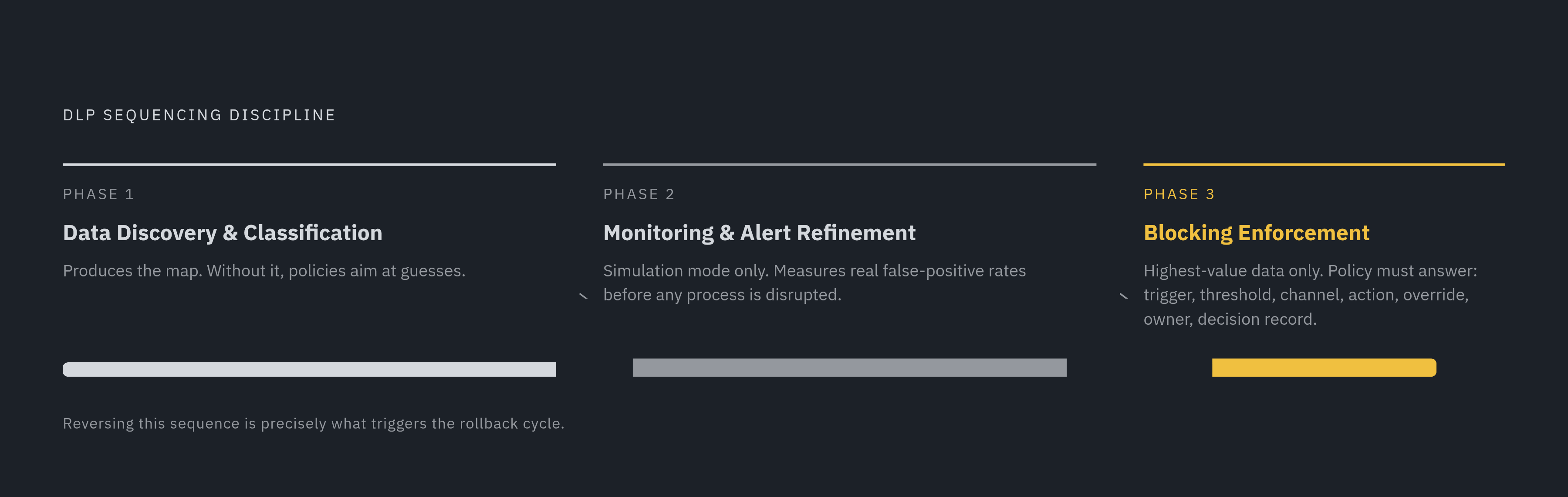
The research converges on a specific order of operations, and the order is not negotiable: data discovery and classification first, monitoring with alert refinement second, blocking enforcement last, and even then applied narrowly to the highest-value data rather than broadly across everything.
The reasoning behind putting blocking last is a matter of rule accuracy, not caution for its own part. A rule built to match the phrase "confidential pricing" is close to a coin flip, and coin-flip rules generate the alert volume that ends programs before they mature. Running every policy in simulation mode before it ever gets to block traffic lets a team measure its real false-positive rate against actual data flows, not projected ones, before any business process gets disrupted.
Getting a policy production-ready also means answering a specific set of design questions before it ever fires: what triggers it, at what confidence threshold, in which channels it applies, what action fires on a match, whether a user can override the block, who owns the resulting alert, and where the decision record lives once the override happens Decryption Digest. If any single one of those is skipped, the policy tends to break, either under an audit or under real operational load. The override path in particular looks like a weakness on first read, a hole a determined user could walk through. In practice, a typed justification required to bypass a block functions as deterrence and leaves an audit trail behind it; programs that eliminate overrides entirely tend to accumulate exception pressure that eventually forces the same rollback cycle described above.
Insider behavior, data value, and risk concentration
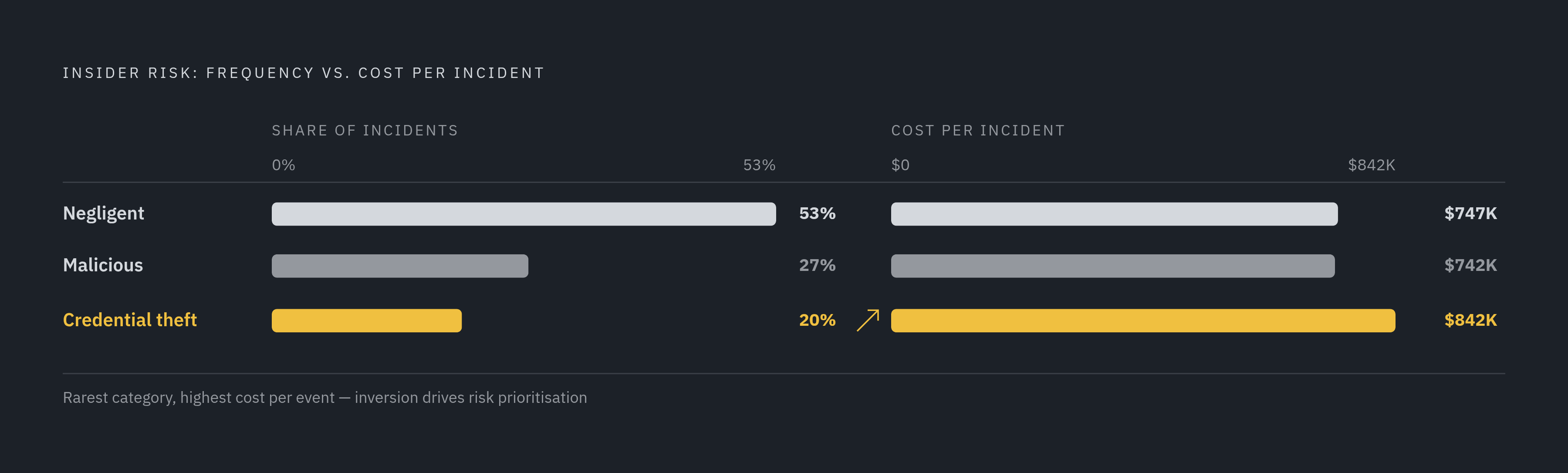
Protecting crown-jewel data means protecting it from people, and the economics of insider risk make clear how much is at stake. The average annual cost of insider-related activity in North America reached $24.0 million in 2025, up from $22.2 million the year before, according to the Cost of Insider Risks Global Report from the Ponemon Institute Decryption Digest.
The composition of that risk cuts against the instinct to build detection around malicious actors alone. Ponemon's data attributes 53% of incidents to negligent insiders, 27% to malicious insiders, and 20% to credential theft Decryption Digest Ponemon Institute. Most incidents, in other words, are mistakes. Yet the cost distribution runs the other direction: negligent events average $747,107 per incident, malicious events $742,125, and credential theft $842,462; the compromised-insider scenario, the smallest share of incidents by count, is the most expensive by a clear margin Ponemon Institute.
A program built to catch only deliberate exfiltration will miss the majority of incidents by volume; a program built to catch only content leaving through known channels will miss the behavioral signal that separates a risky action from a routine one. 93% of organizations rate insider threats as equally or more difficult to detect than external attacks Decryption Digest Cybersecurity Insiders. Confidence lags even further behind capability. Only 14% of organizations feel fully confident in their ability to detect insider data loss, and, as already noted, just 28% have the classification and discovery groundwork that would make detection possible in the first place Heimdal Security Exabeam. Neither the tools nor the confidence to use them are where they need to be across most of the field.
Static rules and the risk in behavioral patterns across a user timeline
Legacy DLP asks one question, over and over: does this file contain sensitive data? It's a reasonable question, and it catches a real share of exposure. But it is not the question that catches an insider quietly moving toward the door, or a new hire whose access was legitimate on day one and whose intent was not.
The questions a value-based program needs to ask instead: who is moving this, where did it originate, is this normal behavior for this specific user, is the user's employment status changing, is this content headed into an AI tool, and does this look like a workflow or a quiet exfiltration attempt? Answering any of those requires context a static rule was never built to hold. Legacy systems match against rules written in advance of any specific event. Behavioral and AI-native systems read the surrounding context, identity, role, recent activity, destination, timing, before rendering a verdict.
That context gap is not academic. Just 8% of employees account for 80% of security incidents, and that statistic is only useful if a system can actually identify which 8% in advance, which demands behavioral context spanning a user's timeline rather than a single content match at the moment a file moves Orion Security Heimdal Security. Modern approaches push the intervention point earlier still, addressing unnecessary access and oversharing before data ever moves, using identity, collaboration behavior, and usage patterns to decide where controls need to tighten, not waiting for a file to trip a keyword. None of this makes content inspection obsolete. It makes clear that content inspection alone was never sufficient to protect what actually matters, only necessary as one layer among several.
GenAI as the coverage gap that volume-based programs are least equipped to close
Legacy DLP was built for a world where data moved through predictable channels, files attached to emails, documents copied to USB drives, uploads to known cloud services. GenAI tools broke that assumption by converting sensitive information into conversational prompts, a form that slides past the content patterns and file-type rules most policies were built to catch.
The Samsung case remains the clearest illustration on record. Within three weeks of allowing employee use of ChatGPT, the company confirmed three separate incidents in which employees pasted proprietary source code and internal meeting notes directly into prompts. No email left the building; no USB drive was involved. The exfiltration channel was the conversation itself. That is not an isolated event, either. A 2025 study that tracked 1.1 million workers found 11% of the data pasted into ChatGPT was classified as sensitive corporate data, and separately, 15% of employees routinely access GenAI systems on corporate devices at least once every 15 days Decryption Digest Orion Security Nightfall AI Cyberhaven / Articles Ledge Bright Defense. Awareness of the shift is nearly universal, 92% of organizations believe GenAI has changed how employees access and share information, but that awareness has mostly not translated into controls Bright Defense. Where it has, the payoff is measurable: organizations running formal GenAI governance policies report data leakage incidents reduced by as much as 46% compared with organizations running no controls at all Practical DevSecOps.
Volume-first programs tend to respond to this shift with a single move: block the ChatGPT domain. That is not GenAI coverage, it is a domain block, and it leaves personal devices, browser extensions, API-connected tools, and increasingly agentic AI systems entirely open. Real coverage requires inspecting prompt content before it submits, a capability most tools that market themselves as "GenAI-ready" do not actually deliver. The next layer of exposure is already visible on the horizon: AI agents connected through protocols like MCP can initiate data movement on their own, with no human action to catch and no endpoint agent positioned to see it happen, which expands the attack surface well beyond anything a single user's actions could create. Whether a vendor inspects prompt content before submission, versus simply blocking a known URL, is a specific and testable question to put directly to any vendor being evaluated.
Value-based DLP coverage in the vendor landscape
Detection itself has stopped being the differentiator among DLP vendors, since most of them detect policy violations reliably enough. What actually separates one platform from another is what happens in the two minutes after that detection fires, and UnderDefense's guide notes that most vendors do not answer that question with any clarity Decryption Digest. That question, more than any feature checklist, is where an evaluation should start.
Cost comparisons deserve the same scrutiny. The same guide states that professional services, policy tuning, and the labor of investigating each alert routinely double the effective cost of a deployment, and the license fee is rarely the largest line item on the bill. A tool with a low sticker price that generates high alert volume can carry the highest total cost of ownership in the portfolio, once that labor is counted. GenAI coverage claims need the same skepticism: "Full" and "Native" coverage means a tool inspects prompt content before it submits, while "Partial" and "Minimal" usually means category-level controls or a URL block dressed up as protection.
Several named platforms illustrate the range of approaches on the market today. Cyera's Omni DLP, launched in April 2025, functions as an orchestration layer over an organization's existing stack, adding context through what it calls "Data DNA," who is using data, why, and what is at risk, then auto-building and auto-tuning policies over time; organizations using it reported over 95% fewer inaccurate alerts and 90% less manual effort spent on policy management and triage Decryption Digest Orion Security B2BNN Nightfall AI Cyberhaven.
Microsoft Purview offers deep native integration across Microsoft 365 with strong compliance and regulatory controls, though its GenAI coverage is limited to Copilot, bundled pricing runs around $60 per user per month under M365 E5, and flexibility narrows considerably outside the Microsoft ecosystem. Symantec DLP, now under Broadcom, covers endpoints, network, and cloud broadly with a mature policy engine and a long enterprise deployment history, but its GenAI coverage is minimal and deployment tends to carry heavy tuning effort. Digital Guardian, under Fortra, centers on endpoint data protection and intellectual property security with strong visibility into data activity, though it, too, carries minimal GenAI coverage alongside heavier deployment and management overhead.
None of these platforms is a universal answer. The right fit depends on where an organization's crown-jewel data actually sits, how much of its exposure already runs through GenAI channels, and how much manual tuning effort its security team has the capacity to absorb, which is precisely the evaluation a volume-first mindset never gets around to asking. Forcepoint DLP enforces unified policies across cloud, web, email, network, and endpoint from a single console; its Risk-Adaptive Protection (RAP) uses native UEBA to calculate each user's risk score and dynamically adjust controls in real time; it is named a Leader in the IDC MarketScape: Worldwide DLP 2025 assessment; it offers partial GenAI coverage (browser-based); and it is estimated at $30–60/user/yr Decryption Digest. Nightfall AI is cloud/API-first, reports 95% detection precision out of the box versus a 5%–25% baseline range for legacy pattern-matching DLP, claims a 99% reduction in false positives, and offers full GenAI coverage via API-native inspection Orion Security B2BNN.