Classification Coverage Gaps Between Policy Definition and Deployed Rules
What happens when security policies become rules that don't cover every channel.

Classification coverage gaps are a translation failure: the moment a policy document turns into a deployed ruleset, whole categories of data, whole channels, whole content types quietly fall outside what's actually being enforced. They're a translation failure: the moment a policy document turns into a deployed ruleset, whole categories of data, whole channels, whole content types quietly fall outside what's actually being enforced. Naming the failure this way changes what a security team goes looking for and where it looks.
The four places where policy intent gets lost in translation
Policy documents say things like "protect cardholder data" or "restrict access to source code." Rulesets don't understand sentences like that. They understand regex, thresholds, channel definitions, and enforcement actions, so someone has to take the sentence and turn it into a pattern a machine can match. That conversion loses information every time, and it loses it in roughly four predictable spots.
The first is data with no rule equivalent. Compliance mandates name specific things, cardholder numbers, health record fields, and those map to rules reasonably well because the data has a fixed shape. Unstructured content doesn't. A contract, a block of source code, a product design file, a strategic memo, a message thread on a team chat platform, none of that has a reliable pattern to match against. Traditional DLP tooling was built for structured, nameable fields, not for governing unstructured content at scale, and the hardest version of this problem is a company's crown-jewel IP: it's sensitive because of what it means to the business, not because it looks like anything a regex can catch.
The second is data that was never found. A rule can't protect a file the system doesn't know exists. Discovery across endpoints, cloud storage, SaaS apps, and network drives has to happen before enforcement can, and it's routinely underfunded relative to the rule-writing that follows it. When that happens, the ruleset only governs the slice of data the platform happened to index, and everything outside that slice is invisible by default, not by exception.
The third is channel scope written narrower than the policy actually intends. Policy language tends to say something like "sensitive data must not leave through unauthorized channels," which sounds complete until you realize rule engines need each channel spelled out by name. Anything not explicitly configured, a new file-sharing tool, a personal cloud drive, is unmonitored because nobody told the ruleset it existed. It's unmonitored because nobody told the ruleset it existed. Scoping work has to identify which systems, departments, data types, and workflows actually fall under a given policy, and when that mapping is incomplete, the resulting gaps aren't edge cases. They're structural.
The fourth is context, and this is the one rules were never built to carry. Rules are stateless: they look at a single event and decide yes or no. Policy intent is stateful. Sending a file to a contractor and sending the same file to a competitor are two very different risks, but a rule sees the same file both times. A document labeled "final v3" tells a rule nothing about the fact that it's a derivative of a board-level acquisition memo. That lineage, what a file came from, who touched it, how it evolved, is exactly the kind of thing a policy author assumes matters and a rule engine has no way to represent.
Channel gaps: where the enforcement surface falls shortest of the policy boundary
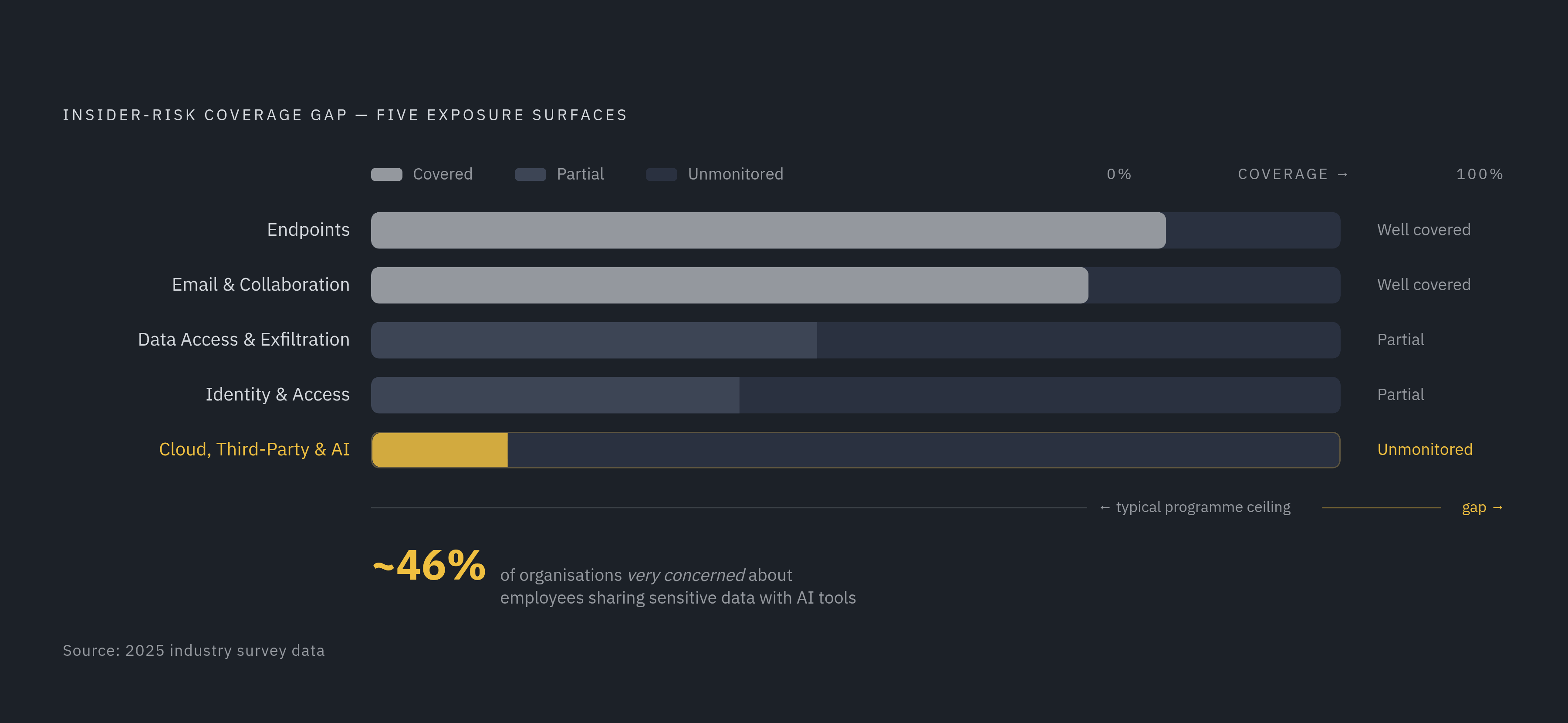
Compliance gaps trace back to channel gaps more often than anything else. A program that watches email closely but ignores cloud uploads, or one that locks down endpoints but not web traffic, is giving partial protection while producing partial audit evidence, and partial evidence tends to read the same as no evidence once a regulator asks for it.
Insider risk research generally groups the exposure into five broad surfaces: endpoints, data access and exfiltration paths, email and collaboration tools, identity and access management, and cloud or third-party systems. Any vendor claiming full coverage across all five surfaces is, in practice, describing a gap they haven't found yet rather than a guarantee they can back up. Most deployed programs handle two or three of these avenues reasonably well and leave the rest partially covered, which is the direct, almost mechanical result of trying to translate a channel-agnostic policy statement into a channel-specific configuration.
Generative AI tools are the newest version of this problem. Surveys from 2025 put a large share of organizations, close to half in at least one industry study, as "very concerned" about employees sharing sensitive data with AI tools. The policy almost never anticipated the channel, because the channel didn't exist when the policy was written. It's already the shape of the gap in a lot of programs today.
Regulators don't grade on a curve here. A gap in one monitored channel counts as a gap for the whole program during an audit, regardless of how well the other channels are covered.
How static rule engines widen the gap over time
Every new application, every new data type, every new way employees move information out the door requires someone to write a new rule or update an old one. That means the ruleset is permanently chasing a target that keeps moving faster than the update cycle. Industry analysis has broadly concluded that conventional DLP struggles to manage the risk generative AI introduces, with encrypted traffic, blindness to user intent, and shadow AI use commonly cited as specific failure points.
Cloud sprawl makes this worse on its own. New SaaS adoption, AI-driven access patterns, and the steady growth of unstructured content are generating new exposure faster than security teams can realistically author rules to cover it. The gap doesn't just exist, it widens on a schedule.
There's a second-order effect that makes things worse still. Teams that feel anxious about coverage tend to compensate by writing broader rules, and broader rules generate more false positives. Legacy DLP deployments are known to throw off large volumes of policy violations that nobody has the staff to investigate, which produces the same alert fatigue problem that's plagued SIEM deployments for years. Once analysts stop investigating candidate events because there are too many of them, violations start passing through channels that technically have rules attached. The rule fires. Nobody looks. Enforcement, in any meaningful sense, is absent even though the configuration says otherwise.
Multi-tool environments multiply this again. Most organizations run DLP, DSPM, CASB, and insider risk tooling as separate products with separate consoles and no shared signal between them. Each tool is enforcing its own partial translation of the same underlying policy, and the gaps fall exactly where those tools don't talk to each other.
The coverage rules cannot express: behavioral and contextual signals
Rules describe the state of data. They can't describe the person moving it, that person's recent pattern of behavior, or what the destination actually means given everything else happening around it that week.
Credential misuse is the cleanest example of where this breaks down. A stolen or misused login produces access events that look, on paper, exactly like legitimate access, because technically it is legitimate access, just by the wrong person or for the wrong reason. A rule keyed to access events has nothing to flag. Nothing about the event itself is anomalous.
Behavioral context is what fills that hole, and most organizations don't fold it into detection nearly as deeply as they'd need to. Industry survey data from 2025 pointed to a real disconnect: security teams broadly recognize insider threat as a serious risk, but far fewer have practical tools in place to manage it proactively rather than after the fact. That gap between recognizing a risk category and actually operationalizing detection against it is where a lot of programs quietly sit.
What contextual coverage adds, specifically, is lineage: knowing where a file originated, who's touched it, how it's been modified, and where it's traveled since. A document that's a direct derivative of something sensitive is itself sensitive, even if nobody remembered to apply a label to the copy. It also adds role and destination context, since the same transfer event carries a different risk depending on the sender's job, the recipient's actual relationship to the company, and the timing relative to everything else going on. And it adds pattern recognition across a timeline, because the risk is almost never a single permitted event sitting by itself. It's the sequence around that event. An organization that can only judge one event at a time against a fixed rule will always miss the risks that only become visible once you look at the sequence.
What a coverage gap audit looks like in practice
A useful starting frame is the share of known sensitive data flows that actually have an active, enforced control sitting on top of them. Everything else in the audit exists to produce and refine that picture.
Step one is a discovery audit. Map out where sensitive data actually lives, endpoints, cloud storage, SaaS platforms, email, on-premises file shares, and do it before trying to measure coverage, because coverage measured against an incomplete inventory is a guess dressed up as a metric. Automated discovery tools that classify data across mail systems, file shares, cloud platforms, and endpoints are the baseline here.
Step two builds a channel coverage matrix: list every egress path the business actually uses and mark each one monitored, partially monitored, or unmonitored. The five insider-risk surfaces, endpoint, data access and exfiltration, email and collaboration, identity and access management, cloud and third-party systems, are a reasonable frame for organizing that list. And this can't be a once-a-year exercise. A classification policy has to be reviewed continually because new tools and threats appear over time, and a static annual audit will simply miss whatever channel opened up in month seven.
Step three builds the same kind of matrix for data types instead of channels: list every category named in the policy and confirm a deployed, active rule actually exists for each one. Unstructured categories deserve particular attention here, since they're the most likely spot to have policy language with no corresponding rule behind it.
Step four is a rule effectiveness review. For every rule that does exist, check its false-positive rate and how often flagged events actually get investigated versus dismissed. A rule that fires constantly and gets ignored isn't providing coverage, it's providing the appearance of coverage. Access governance reviews run alongside this tend to surface a significant number of users carrying more access than their role requires, and authorized access, by definition, sits outside what any rule engine is watching for.
Step five checks the seams between tools: confirm that each platform's alerts actually feed into one shared investigation workflow. If they don't, events fall through the gaps between tools even when each tool, on its own, looks like it's doing its job.
The regulatory exposure created by gaps that audit teams typically miss
As of 2025, 155 countries have data privacy laws on the books. Most multinational companies are operating under several overlapping enforcement regimes at once, each with its own list of required channels and data categories. A gap that looks minor under one regime can be a real problem under another.
A single unmonitored channel can undercut an otherwise strong compliance story, because regulators want proof of active governance on every channel where covered data moves, not a policy document describing what should happen. DLP compliance management, properly understood, means keeping policies configured, enforced, and documented in a way that holds up across every one of those channels, and "configured" and "documented" are not the same standard. A company can produce a well-written policy and still fail an audit if it can't produce evidence that a specific channel was actually enforced against.
The enforcement environment isn't getting gentler about this. European regulators handed out more than a billion euros in GDPR fines in 2025, a substantial increase over the prior year, and that trend line doesn't suggest patience for gaps discovered after the fact. The channel coverage matrix built during an internal audit is, functionally, the same document a regulator will want to see as compliance evidence. A gap in one is a gap in the other.
How to close the gap systematically rather than reactively
Discovery comes first, always. Writing rules to protect data the system hasn't found yet just manufactures false confidence, so treat inventory as a prerequisite step, not something running in parallel with rule-building.
Channel coverage needs to be treated as a living map rather than a configuration set once and left alone. New SaaS tools, new AI products, new collaboration platforms open channels continuously, so the trigger for reviewing coverage should be any meaningful change in how the business actually operates.
Behavioral and contextual detection should sit on top of rule-based controls, not replace them. Rules still handle known, structured data on channels that are already configured, and there's no reason to abandon that. What rules can't touch, unstructured content, context-dependent risk, the pattern of events surrounding a single action, is where behavioral and content-understanding layers earn their place. Sequencing identity-first detection ahead of behavioral monitoring, rather than running both in parallel with no relationship to each other, is one structural approach security teams use to reduce noise and improve investigation focus.ully cuts down investigation time, and that architectural choice affects outcomes more than how many vendors are involved.
Alert volume has to come down for coverage to translate into real enforcement. A rule firing thousands of times a month that nobody reviews isn't protection, it's noise with a paper trail. Triage that filters candidate events before they land in front of an analyst is what makes broad coverage sustainable in practice rather than just on a slide. Time to investigate matters as much as detection accuracy does: a platform that catches the right signal but buries it under everything else hasn't actually closed anything.
Evaluate tools on the seams between them, not on feature lists in isolation. Integration architecture counts for more than the number of vendors in the stack, and if alerts from separate tools can't land in one shared investigation workflow, adding another point solution just adds more manual reconciliation work for someone on the security team. Platforms built to combine modern DLP controls, behavioral detection, and cross-system investigation into a single workflow are solving for exactly this seam problem, and testing that integration directly is a better use of an evaluation cycle than comparing feature checklists side by side.
Finally, make the whole effort measurable. Policy coverage rate, the share of known sensitive flows with an active, enforced control, should be a number tracked and reported in program reviews. And the ruleset needs the same review cadence the classification policy itself requires: continual, not occasional, because the gap doesn't stay still long enough for an annual check-in to catch it.
Sources
- Data classification policy for emerging technologies and threats in 2026
- Insider Threat Vendors 2026: Coverage Gap Guide - Defy Security
- Fix Broken DLP Data Classification | Material Security
- What should organisations do when native DLP leaves coverage gaps?
- primesecured.com
- marktechpost.com
- fortinet.com
- vertosoft.com