How Coverage Collapses When DLP Detection Is Bounded by What Employees Typed Not What They Did
Legacy DLP misses risks hidden in behavior, not just content.
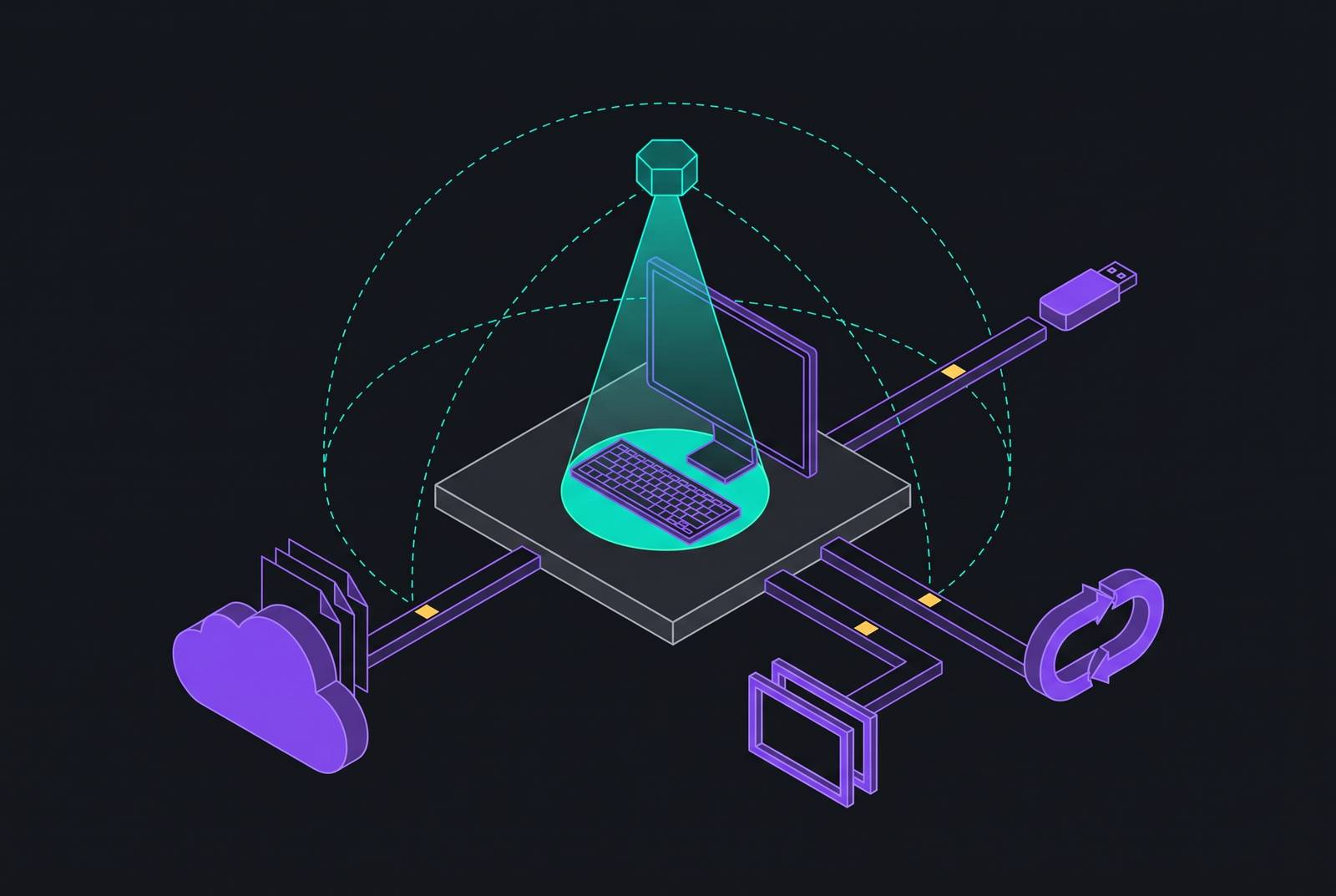
Legacy data loss prevention narrows its coverage when it treats recognized content as the condition for detection. What employees typed, pasted, or transferred cannot, by itself, explain the risk in what they did. Effective coverage combines payload inspection with the person’s behavior, access, and action sequence, then brings that context into the investigation to spare analysts the reconstruction work.
Why content-matching was always a bounded detection model
Legacy DLP checks whether data matches a known pattern. Its rules recognize content through regexes, keywords, classification labels, and file fingerprints at inspection points such as email gateways, endpoint agents, and network proxies. The payload is the basis for the decision. That architecture worked when data stayed inside a stable perimeter and often left through email attachments or removable media. Both the material and its route out were available for inspection.
The design therefore assumes that risk resides in identifiable content moving through a monitored channel. Two gaps follow directly from that assumption. It misses data without a recognized label or match and leaves what else the person does out of the decision. These architectural limits persist even with a larger rule set. When the payload does not match, content-only detection has nothing to trigger on, regardless of how dangerous the action is.
How the modern data environment broke the assumptions that architecture depended on
Generative AI breaks the assumption that sensitive material will arrive in a readily identifiable payload. A strategic plan can leave as natural language typed into a browser text box. Free-form input can hold intellectual property without matching a known signature. A detector built around recognizable files and patterns can therefore miss the submission even when its rules work as designed.
Cloud applications also separate data movement from the inspection points that once defined the perimeter. SaaS applications, API integrations, personal cloud accounts, and AI platforms give data ways out that traditional controls do not cover. Network DLP may see only an encrypted session to a permitted destination, with the employee’s submission hidden inside it. Personal-account use makes that distinction especially consequential for shadow AI. The connection can be legitimate while the disclosure inside it remains invisible.
Remote work and cloud adoption also dissolve the stable boundary that made those inspection points representative of organizational activity. The old perimeter no longer encloses the relevant workflows. Fortinet’s 2025 Insider Risk Report, which surveyed 883 IT and security professionals, documents an expanding GenAI attack surface and a current operational gap, finding that most organizations are not fully prepared to respond.
The classes of exfiltration that fall entirely outside a content-matched detection boundary
In the Coinbase case in January 2025, cybercriminals bribed customer support contractors with authorized access to customer information, including government ID images, account balances, masked bank account numbers, and transaction history. The siphoning continued over months. Each individual access resembled normal support work by someone with legitimate credentials. A content-only decision could recognize the records without distinguishing the access pattern from permitted work.
The OPEXUS case in February 2025 exposed a different authorization gap. Two engineers with prior federal hacking convictions had been hired and given access to government systems. The Senate HELP Committee letter states that, after termination but before access was revoked, they allegedly deleted 96 government databases and exfiltrated approximately 1,800 EEOC files. The relevant signal was the relationship between termination, retained access, volume, and sequencing.
Slow-burn exfiltration places the signal across channels. The Rippling vs. Deel corporate espionage case in March 2025 illustrates incremental movement across Slack, Salesforce, and Google Drive over months. No individual transfer need cross a volume or pattern threshold. Prompt-based AI disclosure can also go unseen, even when no file is transferred. When an employee types a sensitive strategic plan into a GenAI prompt, the proxy can record a permitted destination and the endpoint agent a browser session, with no recognizable content pattern at the network layer to trigger detection.
Why insider risk is primarily a behavioral problem, not a content problem
These gaps arise because insider risk concerns the relationship between an identity, its access, and its actions. Fortinet’s report describes that risk as behavioral and context-driven, embedded in everyday workflows. It also finds that most incidents are unintentional, with negligence and compromised or credential-based behavior accounting for the majority. Malicious intent is not the only detection target. A model calibrated solely for deliberate exfiltration misses the broader population acting through legitimate access.
Behavior supplies distinctions that a payload cannot contain. ISACA’s 2026 DLP analysis describes a developer who downloads large amounts of source code outside normal working hours and an employee who transfers customer lists to a personal device when close to resigning. The files alone do not explain the concern. When and where an action happens, the person’s role, and their employment context change how otherwise authorized activity should be understood. Detection must therefore relate an action to the user’s history and peer group rather than treat permission as evidence that the action is routine.
The same reasoning applies to contractors, third parties, compromised users, and non-human identities as well as employees. Shah et al. 2026 identifies service accounts, API keys, and automated agents as part of an expanded attack surface in which trust can be weaponized. Vectra’s UEBA guide explains that static rules see nothing wrong when someone uses valid credentials through approved channels and appears to have authorization, while behavioral analytics can spot a break from their usual pattern. Authorization is therefore not a sufficient risk test. Content inspection establishes what moved, but insider-risk detection must establish who moved it, when, where, and what preceded the action.
What a bounded detection model costs when it fails silently
A missed match leaves no alert, no investigation, and no opportunity to intervene through that detection path. Fortinet’s report finds that most organizations lack confidence in their insider-threat detection capabilities and widely regard existing DLP tools as ineffective at preventing sensitive data from leaving. It also identifies poor visibility into user interactions with data across endpoints, cloud applications, and GenAI platforms. Without that foundational awareness, a quiet queue cannot establish that data is safe.
The financial consequence develops inside the undetected window. Coinbase’s case involved months of activity, allowing exposure to accumulate beyond the first disclosure. OPEXUS presents a contrasting timing problem, with alleged destruction during the interval between termination and access revocation. Incidents contained quickly cost significantly less than those that continue for months, so silence is not merely a reporting defect.
Intellectual-property loss makes that delay particularly difficult to price. A product roadmap, unreleased algorithm, or regulatory submission reaching a competitor before filing creates damage that cannot simply be reversed by closing an account. The loss extends beyond the transferred material. As the window lengthens, additional access and disclosure can compound the exposure. A detection program’s financial value therefore depends heavily on how soon it makes risky activity available for investigation.
How alert fatigue turns detection failures into operational ones
Even a valid behavioral signal can fail operationally after detection. Unlike a signature match, an anomaly requires interpretation against user history, role, access scope, and peer behavior. Analysts often have to piece those details together from different tools before deciding whether an action is suspicious. That work consumes the intervention window. Fortinet’s report links fragmented tools lacking behavioral insight and contextual awareness to delayed detection and missed opportunities to act.
In an overloaded SOC, context-heavy alerts compete poorly for attention. Legitimate work can look like early insider activity, so it can be hard to confirm a behavioral alert quickly. When staffing does not grow with alert volume, such alerts are more likely to be deferred or bulk-closed, and a large fraction never receive full investigation. A platform that generates an anomaly but leaves its meaning scattered across systems shifts essential detection work into the analyst queue.
Analyst attrition makes that dependency more fragile. Experienced practitioners take knowledge of normal user behavior with them when they leave, reducing both interpretive quality and triage speed. Even with more training, analysts still have to piece together what happened across systems. Mean-time-to-investigation consequently becomes as important as detection accuracy in determining whether a signal leads to intervention.
What detection looks like when the person's behavior is part of the signal
A broader detection model evaluates content within an ongoing record of identity and behavior. Vectra’s guide describes baselines for users and entities, with deviations assessed against relevant peers. A finance analyst belongs against other finance analysts. An anomalous login may contribute little alone, but abnormal downloads and access to a previously untouched repository give that login a different significance. The combined sequence becomes the signal.
The timeline must also retain the context that changes how actions should be interpreted. A denied promotion, termination notice, or role reassignment can update a user’s risk assessment without waiting for a content match. Shah et al.’s BTCE model incorporates precipitating events and behavioral biases, including present bias and loss aversion, and demonstrates earlier detection than rational baselines. Such inputs serve only as context for assessing subsequent behavior, including sequences such as code edits followed by scripted exports that isolated-event inspection would separate.
Content inspection remains part of this model because behavior does not establish everything about the data being moved. For GenAI interactions, the useful signal combines the submitted data, the destination account, and the session context rather than treating a permitted domain as sufficient evidence of safety. The model must also cover the behavior of service accounts, API keys, and automated agents. ISACA’s analysis describes continuous activity monitoring and behavioral analytics that make detection an ongoing assessment, flagging anomalies so they can be investigated.
The investigation context must arrive with that assessment. User history, role, peer comparison, data context, and access timeline belong in the alert’s reasoning chain to spare analysts a reconstruction exercise across five tools. A score alone is insufficient for analyst trust. Showing the sequence and contextual factors allows triage to become a decision about evidence already assembled. This connects the expanded detection surface to the operational capacity needed to use it.
What organizations should expect from a detection program that covers the full behavioral surface
A program should detect an authorized user whose volume grows over a two-week period even as their access stays within permissions, approved channels, and normal working patterns. A content match should not be a prerequisite. The corresponding investigation test is whether the analyst can reconstruct the full story in one system. Requiring visits to multiple systems exposes a structural delay even when the underlying signal is accurate.
Contractors, service accounts, and API integrations should receive the same fidelity of assessment as full-time employees on managed endpoints. Fortinet’s report identifies contractors and departing employees as specific high-concern populations, making gaps there particularly consequential. Shadow AI requires an equally specific test. The program should assess the data submitted, whether destination accounts are personal or corporate, and the session context, because blocking a domain still leaves the risk of personal-account use on permitted services.
Behavioral detection produces false positives and requires calibration, and scores without reasoning chains can erode analyst trust faster than noisy signature alerts. A program should combine content and behavioral signals while reducing queue noise. A program should show the action sequence, peer comparison, and contextual factors while reducing the work needed to investigate them. The detection boundary is a choice, and leaving it anchored to content is a choice about which employee actions the organization is willing to miss.