How Employees Reconstruct Sensitive IP From Fragments and Notes
Thieves quietly assemble stolen secrets one small piece at a time.
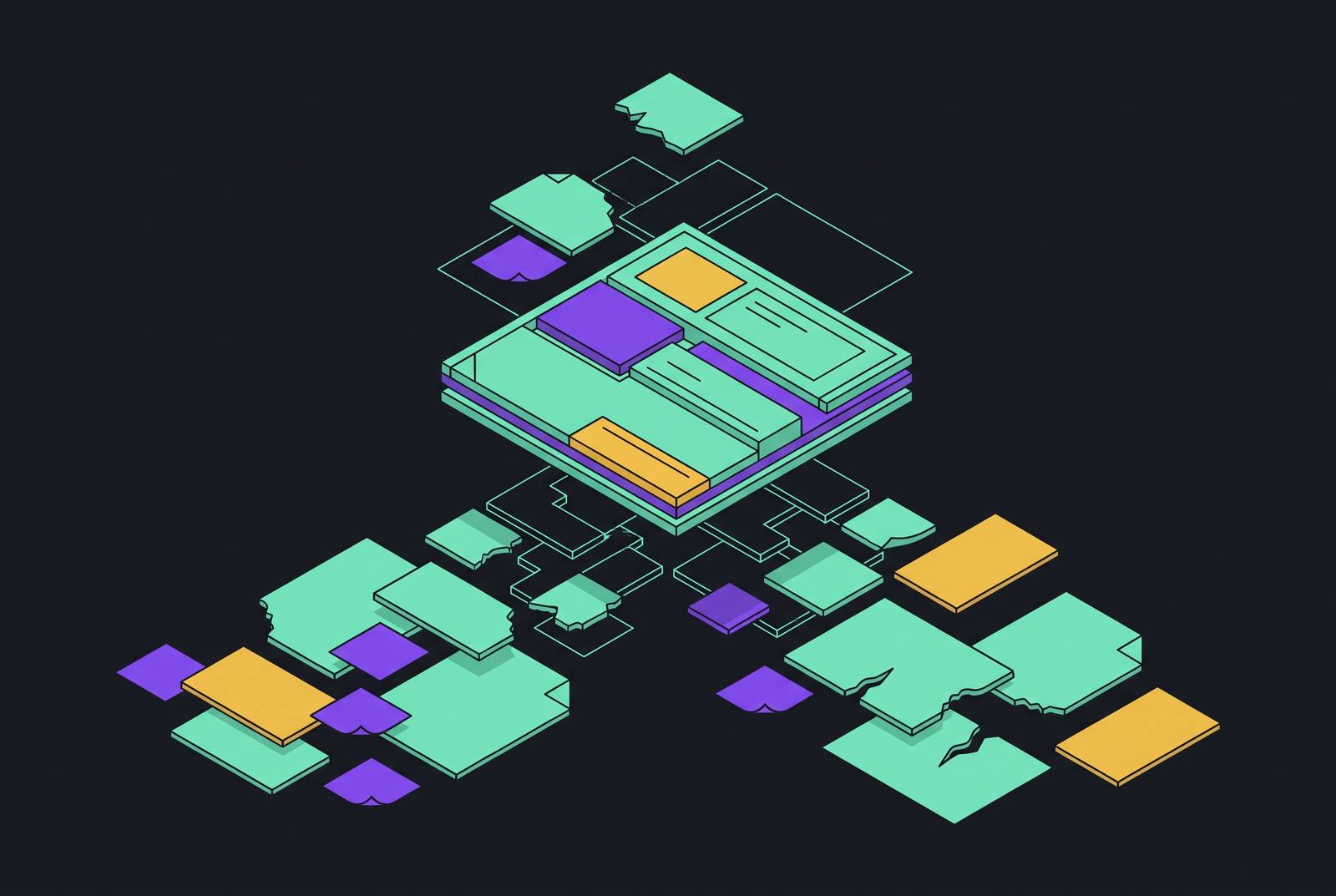
The dominant pattern of intellectual property theft is not the dramatic bulk download, but the quiet, incremental assembly of fragments across months. Each fragment is too small to alarm anyone, yet together they reconstitute the entire asset. Understanding how this reconstruction works is the prerequisite for building detection that can see it.
A developer screenshots a design document. A scientist pastes a proprietary formulation into a generative AI prompt to debug a synthesis problem. An engineer commits a partial algorithm to a personal repository under the label of portfolio work. Each looks like ordinary work, done by an authorized person with approved tools.
The structural reason this pattern dominates is that sensitive data no longer resides in one place. It is dispersed across SharePoint, OneDrive, Google Drive, S3, Slack, Confluence, Salesforce, Dropbox, and dozens of smaller SaaS systems, each with inconsistent audit logging. An employee who wants to reassemble a complete picture of a technology, a formulation, or a pricing strategy does not need to exfiltrate a monolithic file. They need only to touch many small pieces over time, and that distributed reach is precisely what the modern enterprise hands to every trusted identity.
This pattern cuts across every category of insider risk, which is why it cannot be dismissed as a rogue-employee problem. A malicious actor fragments movement deliberately to remain under alert thresholds. A negligent employee reconstructs IP accidentally through habitual productivity workflows, pasting proprietary content into an unsanctioned AI tool to solve an immediate technical problem. A departing employee leaves with mental models and informal notes built over months of legitimate work. Fortinet's 2025 Insider Risk Report found that most incidents stem from unintentional user actions, not malicious intent. The reconstruction problem is therefore structural, embedded in how work is done, not merely how it is attacked.
The sectors most exposed are those where IP is most portable as fragments: technology, where value lives in source code, algorithms, and architecture. Life sciences, where manufacturing know-how and formulations constitute the crown jewels. And any industry where competitive advantage resides in how things are done rather than what is publicly known. Flashpoint's 2026 insider threat analysis documents that threat actors explicitly target these environments because insider access circumvents multi-million dollar security stacks more efficiently than external exploits ever could. The adversary does not need to break in when the person who already holds the badge can be induced, recruited, or simply allowed to carry the pieces out one at a time.
The six channels through which fragments move
Fragment exfiltration exploits the same tools employees use every day, which is precisely why it is so difficult to distinguish from legitimate work. The channels are not exotic. They are the ordinary surfaces of modern knowledge work. A security program that does not monitor these surfaces is blind to the primary pathways through which IP actually leaves.
Generative AI prompts are now the fastest-growing channel for corporate-to-personal data movement. Fortinet's 2025 Insider Risk Report identifies GenAI adoption as a major expansion of the attack surface, with most organizations reporting they are not fully prepared to respond to it. LayerX's State of AI Usage Report 2026 finds that 47.11% of enterprise AI conversations happen through personal identities rather than corporate-managed accounts, so the organization has no audit trail and no enforcement point for nearly half of all AI interactions.
Personal cloud storage receives fragments that look like normal file synchronization. Personal code repositories and version control systems receive partial source code, configuration files, and proprietary algorithms under the cover of portfolio building or personal projects. Each commit is small. The cumulative picture is the IP.
Email forwarding, the oldest channel, still works because it needs no technical sophistication. There is no file to block, no transfer to intercept. This is the channel that makes employment agreements and exit interview protocols relevant as complements to technical controls.
Hive Security's 2026 insider threat analysis captures the modern topology precisely: sensitive data now lives across those dispersed platforms, and attackers and insiders often do not need to touch a server. They query the system that already holds the data. The channel is the workflow.
What confirmed cases reveal about how reconstruction actually unfolds over time
Every confirmed large-scale IP theft case shares a common structure: a multi-month timeline, multiple platforms, and no single act that would have triggered a conventional alert. The documented record moves the argument from hypothetical to empirical. The Hytera case, involving Motorola trade secrets, is the canonical fragment-reconstruction theft. In 2025, Hytera pleaded guilty to felony conspiracy to commit theft of trade secrets under the Economic Espionage Act. The architecture of the theft, engineers moving material piecemeal with operational IP assembled at the destination, is the template for what detection needs to see. It was a process.
A forensic reconstruction case at a Fortune 100 industrial manufacturer shows the temporal dimension with unusual clarity. The exfiltration timeline stretched across 14 months and was reconstructed across six enterprise platforms. The theft was the pattern.
Scale through repetition appears in the Yahoo case, where a senior research scientist downloaded approximately 570,000 pages of trade secrets related to the AdLearn product minutes after receiving a job offer from competitor The Trade Desk. The Apple case against Oppo, filed in August 2025 over Apple Watch trade secrets passed to the Chinese firm, shows that even hardware-adjacent IP such as schematics and design specifications moves through personnel, not network exploits. The U.S. Justice Department secured a guilty plea, but the theft had already occurred before detection because there was no behavioral context surrounding the act at the time it happened.
The pattern across all cases is consistent. Discovery is late. The reconstructed IP is already operational at the destination by the time legal action begins.
Why single-event, rule-based detection cannot see the pattern
Legacy data loss prevention and rule-based detection were designed for a world where sensitive data lived in one place and theft looked like a discrete, policy-violating event. Neither assumption holds in the modern enterprise environment, and the consequences are structural. The mismatch is fundamental. Rules fire on individual events, but reconstruction happens across many events, and none of them violates a rule. The rule that would catch any of these individually would produce so many false positives that analysts would disable or ignore it.
The alert threshold problem compounds the issue. Fragments are individually below every reasonable threshold, but the aggregate is the entire IP. If you lower thresholds to catch fragments without behavioral context, you get more alerts than any security operations team can process.
The platform-silo problem means most organizations cannot correlate behavior across endpoints, cloud applications, and GenAI platforms. Fortinet's 2025 Insider Risk Report found that a significant majority of organizations cannot see how users interact with sensitive data across these three surfaces, and the blind spot is exactly where fragment reconstruction lives. Each platform sees a small, normal event.
There is also a label dependency problem. Unlabeled IP is the most valuable IP and the least likely to trigger content-based rules. A process-control algorithm representing $400 million in competitive value may carry no classification label. IP becomes sensitive because of what it means to the business, not because it matches a pattern.
Finally, the normal-work camouflage problem pervades everything. Hive Security's 2026 analysis frames this precisely: the dangerous account is not always the one breaking in. It is the one that already has a badge, a mailbox, a VPN profile, and access to the folder everyone forgot was sensitive. Living-off-the-land behavior inside M365, cloud consoles, and SaaS admin panels leaves no malware footprint and minimal anomalous signal. The detection model that was built to find violations cannot find work.
What behavioral signals actually reveal the reconstruction pattern
Detecting fragment reconstruction requires correlating identity, data, device, and behavior signals over time across platforms, not matching a single event to a rule. A developer accessing financial records they have never touched before is notable. The same developer doing so weekly for a month while also cloning repositories and connecting new OAuth applications is a pattern warranting investigation. The timeline must be evaluated for meaning, not merely for deviation from a statistical baseline.
The signals that matter are individually explainable but collectively constitute the reconstruction pattern. They include downloading or exporting significantly more data than the user's established baseline, accessing sensitive folders, repositories, tickets, or CRM records outside the person's role, and creating new OAuth grants, access tokens, personal API keys, or mailbox forwarding rules. Large file synchronization in the period before resignation, termination, or contract end is another signal, as are privilege changes shortly before unusual data access and connections to personal, non-corporate AI accounts from enterprise devices.
Hive Security's 2026 analysis establishes the correlation principle: none of these signals proves malicious intent alone. Behavioral pre-indicators also often precede technical exfiltration. Resistance to oversight, unjustified requests for access beyond role, and communications with competitors are documented nontechnical warning signs.
The departing-employee window is the highest-risk period for fragment reconstruction. In the sales manager scenario, exports of customer lists, pricing notes, and renewal dates occur in the final week, using the CRM exactly as designed, with no anomalous login and no policy violation. To detect this you need to know the window exists, which means integrating HR signals such as resignation date and notice period with data-access monitoring.
The identity-continuity problem extends the risk beyond departure. Hive Security's 2026 analysis documents the offboarding failure precisely: disabling the user in the identity provider is not the same as revoking access. SaaS applications, unmanaged devices, shared credentials, and personal API tokens can all survive the checkbox.
How detection architecture needs to change to catch aggregated, low-signal patterns
Catching fragment reconstruction requires a detection architecture that operates across the full user timeline, not a set of rules that evaluate individual events in isolation. Flashpoint's 2026 analysis documents that tool sprawl produced multiple insider dashboards without converging into an architectural shield. Correlation between HR, IAM, cloud, and endpoint remains the exception, not the rule. The 14-month, six-platform case is unsolvable without this unification because each platform in isolation sees a normal event.
Context-aware detection is the second requirement. Detection that cannot hold the user's role, access history, and surrounding behavior in context will always misclassify one of these cases. Understanding both the data and the person, what the information means, where it is going, who is interacting with it, and the surrounding pattern of activity, is what separates context-aware detection from rule-matching.
The user timeline must become the unit of analysis. Detection systems need to accumulate and weight signals across days and weeks, not reset with each session. Risk baselines are not enough on their own because risk may exist from day one, stay statistically normal throughout, or happen entirely through authorized access.
Shadow AI must be treated as a detection requirement, not merely a policy problem. Controls need to operate at the level of the data, the destination, the account ownership, and the context, intervening before sensitive content leaves rather than after. Fortinet's 2025 Insider Risk Report identifies shadow AI as a major unresolved gap, with most organizations, 72% by the report's finding, unable to see how users interact with sensitive data across endpoints, cloud applications, and GenAI platforms.
AI-assisted investigation is the answer to the alert-volume problem. More coverage without AI investigation means more analyst work, the inverse of what lean SOC teams need. Reducing mean-time-to-investigation is as important as detection accuracy. A platform that surfaces the right alert but buries analysts in triage work has not solved the problem.
What a capable platform provides in this context follows logically from these requirements. It provides shadow AI controls operating at the data and destination level, not merely as a blanket block. And it provides deployment speed that makes protection operational before the next offboarding cycle, in days rather than months.
What organizations should do before the next fragment leaves
The detection architecture argument is necessary but not sufficient. The organizational conditions that enable fragment reconstruction must also be addressed: excessive access, weak offboarding, unmonitored AI adoption, and fragmented tooling. Scoping access reduces the blast radius of any single identity. Role-based access controls that limit reach do not eliminate the risk, but they shrink what any one insider can assemble. Hive Security's 2026 analysis frames the core principle: the useful question is not which employee is bad. It is what one trusted identity can reach if trust stops being deserved.
Offboarding must be treated as an identity-containment operation, not HR paperwork. The identity provider disable is not enough. SaaS accounts, refresh tokens, personal device files, API keys, and shared credentials must be explicitly addressed. The departing-employee window, where fragment activity intensifies, requires accelerated monitoring before access is revoked, not just at the moment of departure.
Cross-platform logging needs to be usable. Fortinet's 2025 Insider Risk Report finds that 72% of organizations lack visibility across endpoints, SaaS applications, and GenAI platforms, a significant gap in insider risk programs. An AI use policy should operate at the data and context level, not just the tool level. Controls need to be applied based on what data is being submitted, to which destination, and from which account, so legitimate AI productivity is preserved while sensitive IP is protected before it leaves.
HR signals must be integrated with technical monitoring for the highest-risk windows. Resignation dates, performance review outcomes, and role changes are leading indicators of the windows where fragment activity intensifies. A detection model that does not know an employee has resigned cannot weight the final two weeks of access activity correctly.
Finally, evaluate detection tooling on its ability to see the pattern, not merely the event. The right evaluation question is not whether a tool alerts on large downloads. It is whether the tool can reconstruct a 14-month, six-platform behavioral timeline and surface it before the IP is operational at a competitor. Fortinet's 2025 Insider Risk Report found that most organizations are not confident in their current detection capabilities, and the gap between budget investment and actual program effectiveness reflects a tooling model still catching up to the threat.